



VisionFence represents the "eyes and brain" of modern robotic mowing, shifting the technology from simple movement to true environmental awareness. By fusing camera optics with sophisticated AI algorithms, this system allows mowers to "see" their surroundings, enabling them to identify and deftly navigate around complex obstacles such as trees, garden borders, and walls. This breakthrough moves beyond basic collision avoidance, offering a level of intelligent perception that fundamentally changes how autonomous mowers interact with your lawn.
The Evolution of VisionFence™: Moving Beyond Blind Sensors
Prior to 2022, the standard for robotic mowers involved "blind" navigation using ultrasonic waves or physical bumpers. These methods struggled with accuracy and often failed to notice low-profile items like picnic blankets. The launch of VisionFence™ 1.0 in 2023 revolutionized this by introducing the industry's first visual-based AI system, effectively giving mowers the ability to see and process their environment rather than just reacting to physical contact.
Driven by rapid developments in neural networks and deep learning, the VisionFence™ team remains at the forefront of the market. They are constantly refining the technology to satisfy the growing consumer desire for mowers that offer higher autonomy and smarter decision-making capabilities.

VisionFence™ for H & i Series: Wide-Angle Mastery and Edge Definition
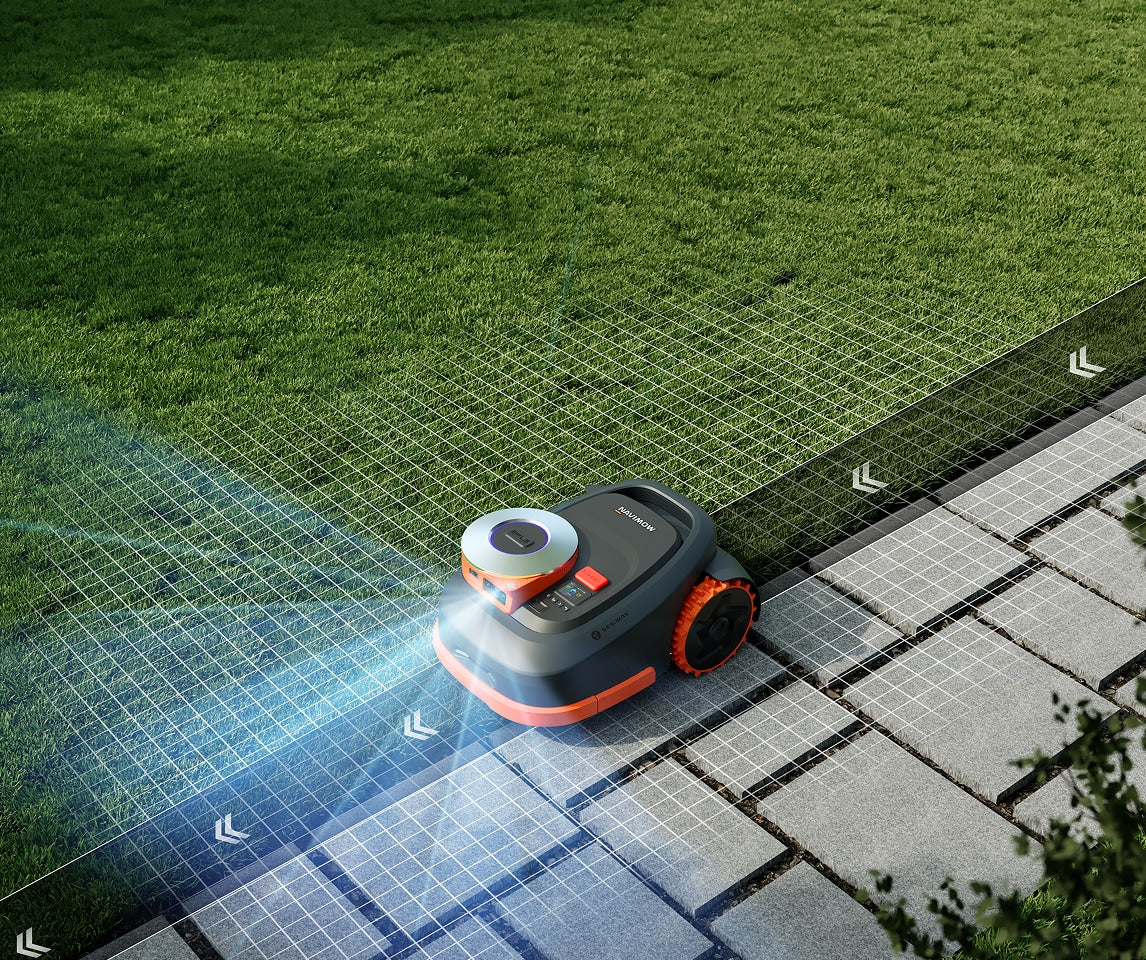
For the H and i Series, VisionFence™ utilizes a specialized fisheye camera system that provides a massive 150-degree field of view. This visual input is processed in real-time to clearly distinguish between the lawn, the physical boundary, and common yard obstacles. It serves as the foundation for smart navigation, ensuring the mower understands exactly where the mowable area ends and the garden begins.

VisionFence™ for X Series: Panoramic 3D Perception
Taking perception to the next level, the X Series implementation of VisionFence™ combines a triple-camera array with Time-of-Flight (ToF) sensors to achieve a near-complete 300-degree field of view. This setup creates a rich, three-dimensional understanding of the environment. The enhanced processing power allows the mower to detect irregular objects with incredible specificity, ensuring that everything from intricate flower beds to scattered toys is identified and avoided smoothly.
This iteration ensures that as garden landscapes become more complex, the mower's ability to navigate them remains flawless, cementing VisionFence™'s position as the leader in AI-assisted lawn care.

Setting the Standard for Intelligent Mowing
Precision over Guesswork: The Visual Advantage
Traditional bumpers and ultrasonic sensors operate on a "trial and error" basis, often lacking the finesse required for complex gardens. VisionFence replaces this with visual certainty. By optically verifying obstacles and boundary lines, the system eliminates guesswork, ensuring the mower covers the entire intended area without encroaching on prohibited zones or getting confused by landscape variations.
Contextual Awareness: Knowing What Lies Ahead
VisionFence™ doesn't just see "an object"; it understands context. The AI is trained to classify items into specific categories—such as flora, garden tools, hanging laundry, pets, or humans. Because it knows what it is looking at, the mower can deploy the most appropriate avoidance maneuver for that specific object, balancing safety with operational efficiency.
Semantic Segmentation: Mapping the Safe Zone
Through semantic segmentation, the mower analyzes the video feed pixel-by-pixel to separate "drivable" terrain from "non-drivable" hazards. This creates a dynamic map of the lawn, allowing the robot to confidently mow around picnic mats or tree roots while knowing exactly which patches of grass are safe to traverse. This makes the mowing path fluid and adaptable to changing garden layouts.

Navigating Complex 3D Structures
Standard 2D cameras often miss objects that don't touch the ground, but VisionFence™ includes specialized algorithms for suspended obstacles. This ensures the mower detects and avoids "overhanging" hazards like patio chairs, tables, or vehicle bumpers, preventing the chassis from getting wedged under furniture or machinery.

Safety First: Proactive Human Detection
The system prioritizes human safety through dynamic speed adjustment. When the VisionFence™ camera spots a person, it doesn't just stop; it intelligently slows the vehicle down based on proximity. This allows the mower to maintain productivity when you are at a distance, while instantly entering a caution mode as you get closer.

Wildlife Protection Protocol
We have integrated a dedicated animal detection mode that scans for wildlife and pets up to 5 meters ahead. Unlike standard obstacle avoidance, this protocol is stricter: upon seeing an animal, the mower alters its path to ensure a minimum safety buffer of 1 meter is always maintained, keeping your pets and local wildlife safe.
High-Fidelity Detection for Thin Objects
Some of the most dangerous obstacles are the hardest to see, such as garden hoses, thin pipes, or wires. Our keypoint detection algorithm is specifically tuned to recognize these slender objects, allowing the mower to navigate around fine details that other sensors might miss entirely.
Self-Diagnostic Vision Maintenance
To guarantee that the AI is always making decisions based on clear data, VisionFence™ includes a lens health monitor. If the camera lens becomes obscured by mud, grass clippings, or dust, the system alerts the user that the "eyes" need cleaning, ensuring the robot never operates with compromised vision.
Share