If you live in a neighborhood with lawns on every side, you have probably witnessed that when spring arrives and the mowing season starts, the air fills with a jumble of loud engines traveling across fences, until it becomes irritating. Have you ever wondered if this is because the machines are old, or are lawn mowers themselves always this noisy?
Traditional gas-powered mowers are loud, producing around 80 to 90 dB(A); riding units climb even higher, up to 100 dB(A). In contrast, electric and robotic mowers are noticeably quieter,<60 dB(A), and that difference is one reason they’re becoming more common.
Read through this blog to find out exactly how loud a lawn mower is. We’ll be unravelling the sound levels for all types of mowers, whether that amount of noise poses any health concerns, and why switching to robotic mowers may be better.
Understanding Lawn Mower Noise
A lawn mower is a mechanical device, traditionally powered by an engine. And just like your car engine produces a certain amount of noise, but that gets softened by the hood and insulation.
A mower has no such enclosure. Everything is open. The engine, the blade, and the airflow all release their sound directly into the air, which is why the noise feels sharp.

But how do we actually quantify that noise? There’s a unit of sound intensity measurement called the decibel, or dB(A). Everyday sounds have their own ranges, and mower noise sits noticeably higher than many of them.
To explain, we would like to quote some examples. A normal human conversation sits around 60 dB(A). Light traffic might be 70 dB(A). A typical gas mower easily breaks past that and climbs into the 80–90 dB(A) range. The sound range between 60 and 70 dB(A) is bearable, but above that level, we call that sound noise.
Typical Noise Levels by Mower Type
You may be aware of the fact that lawn mowers are available in different types: traditional ones powered by gasoline engines, some run on electricity, and some are powered by batteries.
Due to their different energy sources as well as running mechanisms, there’s a significant sound difference among them.
Manual Reel Mowers
These are the most basic types, where no engine or motor is involved. Instead, the cutting action is generated by human push. So the sound level is around 60 to 70 dB(A). Being human-powered, they require more effort and more time. They only make sense if you have a small lawn.

Gas-Powered Push Mowers
These are an upgraded form of manual mowers and have been common for ages. They are powered by gasoline (combustion) engines that produce a significant amount of sound, roughly 80 to 90 dB(A), similar to traffic noise. They are also bulky, and maneuvering them can be tiring.

Riding Mowers
Mowers with four wheels, similar to a small vehicle, and you sit on them while mowing. That naturally means you need a bigger engine and more noise, usually around 85 to 100 dB(A).

Electric/Corded Lawn Mowers
A type of push mower powered by electric motors, which are far more efficient than combustion engines and produce less noise. You can expect around 65 to 80 dB(A), depending on the model and load.

Robotic Lawn Mowers
Robotic lawn mowers are the most advanced form of electric mowers. They use energy-efficient motors with very low noise levels, around 55 to 60 dB(A), sometimes even lower than a normal conversation. They run autonomously on rechargeable batteries and are well-suited for small to medium-sized lawns.

Factors Affecting the Noise Level of a Mower
By now, you’ve probably noticed how every mower type sounds different. That’s because several variables change the way sound is produced and carried.
Engine vs Electric Motor
There’s a significant sound difference between gas and electric mowers. The former one uses an engine that creates noise from multiple sources at once: combustion bursts, exhaust flow, air intake, and the mechanical parts moving inside it. All of this is exposed on a mower, so the sound spreads easily.
Whereas, electric ones use a motor. You mostly get a light mechanical hum, some bearing sound, and airflow from the blade. That’s why electric and robotic mowers usually drop 15 to 25 dB(A) compared to similar gas units.
Blade Design
Blades make noise mainly due to airflow. The faster the blade tip speed, the more turbulence it creates. A 21-inch blade spinning at typical mower RPMs can reach tip speeds above 260 ft/s, which naturally produces a strong aerodynamic rush.

Deck Size
The deck acts like a chamber around the blade. Research has shown that a large or thin metal deck vibrates and can amplify sound. Stiffer decks or ones with internal baffles control how air moves out, which keeps noise from echoing.
Age and Wear
Wear affects both mechanical and aerodynamic noise. Dull blades increase turbulence and drag, which raises aerodynamic noise and forces the engine or motor to work harder. Similarly, worn-out parts (bearings, loose fasteners, vibration mounts) create additional tonal and structure-borne noise.
Health and Comfort Considerations When Using Mowers
Normally, if you are using an electric mower or a robotic mower, the sound levels stay well within safe limits, usually around 55 to 70 dB(A). These levels are comparable to normal conversation, so they don’t pose a risk to hearing.
However, long-term exposure to sound above 85 dB(A) can lead to gradual hearing loss. This is where gas-powered mowers become a concern, since many of them regularly operate in the 85–95 dB(A) range.
According to OSHA, the permissible exposure limit is 90 dB(A) for 8 hours, and for every increase of 5 dB(A), the safe exposure time is reduced by half. So running a gas mower for long periods, especially in close proximity, pushes you into the range where hearing protection becomes necessary.

The Rise of Quiet Mowing: Why Robotic Mowers Stand Out
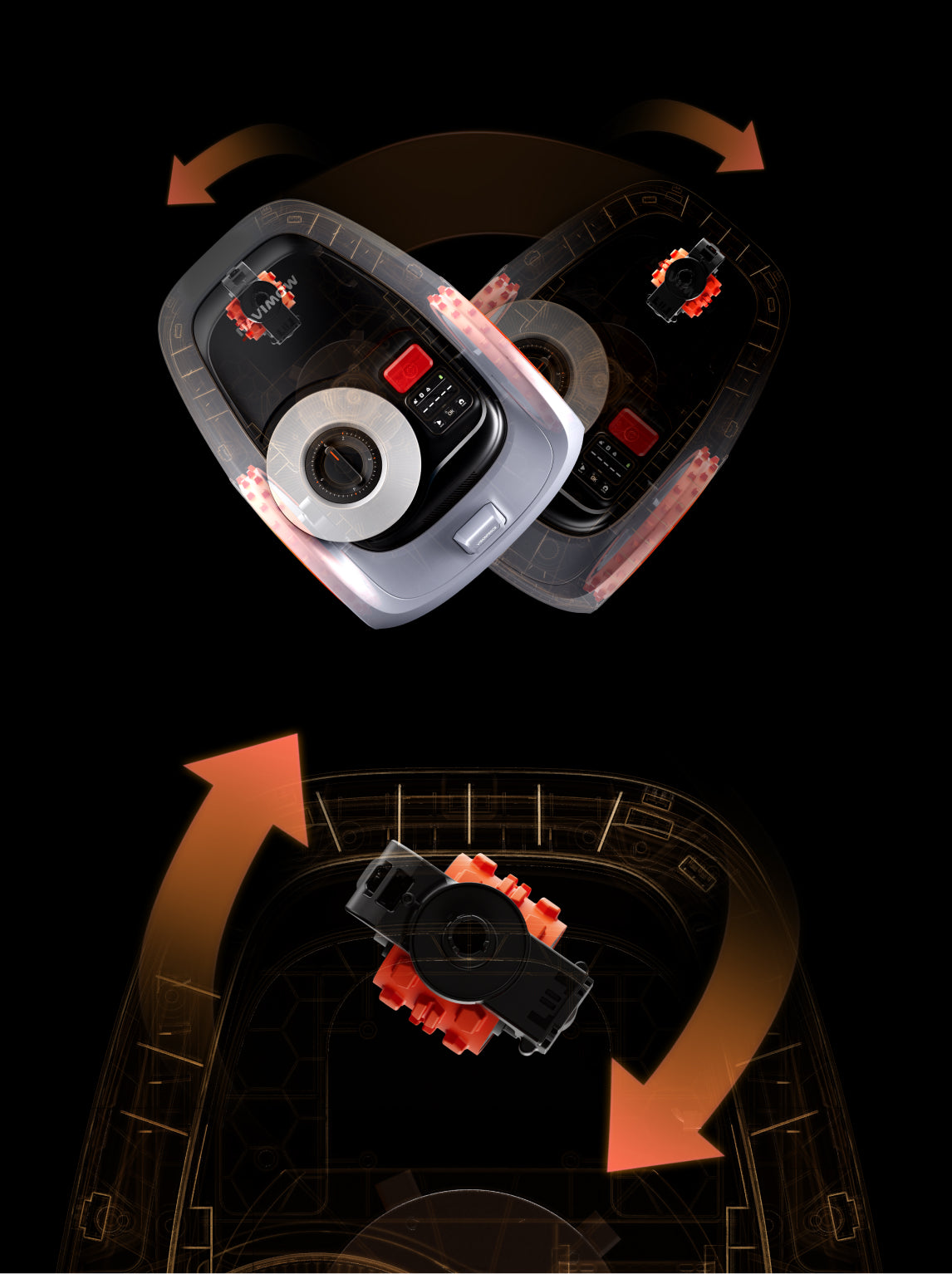
Lawn mowers have long been a loud, noisy presence in any neighborhood, but robotic lawn mowers, like the Navimow Robotic Lawn Mowers, are among the quietest options you can get today, with sound levels as low as 54 to 68 dB(A), depending on the model.
Here’s how these mowers cut down noise and create a much calmer mowing experience:
Continuous micro-cutting
Robotic mowers trim small amounts of grass in each run. This keeps the cutting load low, reduces blade turbulence, and naturally keeps the noise level down.
Energy-efficient electric drive system
They use compact electric motors instead of combustion engines. With no combustion, power stroke, exhaust, and far fewer vibrating parts, the overall sound output is minimal.
Less operator exposure
Since the user isn’t standing behind the machine, you aren’t subjected to the sound at close range. The mower works autonomously on its own (once programmed); you stay comfortably away from the noise source.

FAQs
Are lawn mowers noisy?
No, most lawn mowers these days aren’t as noisy as they used to be. Riding lawn mowers can still reach up to 100 dB(A), but on the other side of the spectrum, robotic mowers are very quiet, around 58 dB(A), even lower than a normal human conversation.
How many decibels in a lawn mower?
It varies widely by type. Electric and robotic mowers usually start around 55 dB(A), while gas-powered riding mowers can climb all the way to 100 dB(A).
How loud is a robotic lawn mower?
Robotic lawn mowers, including models like the Navimow robotic lawn mowers, are considered some of the quietest mowers on the market, with sound levels around 54 to 68 dB(A).