Lawn owners get robot lawn mowers to automate lawn mowing and make their lives easier. But the most common problem they face is that the mower keeps getting stuck. It actually makes them frustrated because they have to rescue the mower every now and then.
Robot lawn mowers get stuck in the middle of operation because of uneven terrain, satellite signal dropout, slippery surface, and various other reasons. They show an error on the display or push notification, and cannot resume mowing until the issue is resolved.
In this article, we will discuss every possible reason why robot mowers get stuck. Not only that, but we will share some simple solutions for lawn owners. We will also explain how the latest and high-tech robot mowers address these issues with modern technology.
Reasons Robot Mowers Keep Getting Stuck
Uneven Terrain
The most common reason for a robot mower getting stuck is the uneven terrain. Small ruts, divots, holes, and even bumpy areas can stop the mower.
Suppose a robot mower is going smoothly, but one of its wheels falls into a divot. The mower's weight shifts, and it loses traction on the ground. That's why it doesn't move in any direction. In this case, the user has to rescue the robot and leave it at any other place in the lawn.

Usually, the front caster wheels of the mowers get stuck. They don't have the power to come out of a divot. However, if the divot is a bit large, the rear large wheels can also get stuck.
Lawn owners need to keep their lawns perfectly leveled for a smooth mower performance. If there is any divot or uneven area, they should top dress it and level it out. However, it's a bit difficult to maintain a plain lawn because of the wildlife and pets.
Excessive Slope/Incline
Robot lawn mowers are designed to work on a certain slope. They definitely perform better than riding mowers on an incline, but there is still a limit.
Most robot lawn mowers can handle slopes up to 15-20⁰. If you try to mow a steeper slope, the robot mower might get stuck.

However, some robot mowers can even mow on a higher slope, such as 20-30⁰ or even more. It depends on the design, drive system, and other factors.
Before buying a robot mower, you should know how steep the slope is in your lawn. Then, it will be easier to buy a suitable robot mower.
Satellite Signal Dropout
Modern wire-free robot mowers rely on satellite signals to navigate the lawn. Without the satellite signals, they get stuck as they do not have a clue where to go.
Satellite signals usually drop if the mower is under a thick tree canopy, in a narrow space, or around a multi-story wall. Because of the blocked signals, the mower doesn't move and shows an error.
For better signal strength and coverage, users need to place the RTK antenna at a suitable location. They can either clear dense tree canopies by cutting a few branches or avoid mowing such areas.
The best way is to upgrade to a robot mower that offers Network RTK and has multiple navigation technologies.
Vision Navigation Failure
Lawn mowers also navigate through vision technology. They have a built-in camera to visualize the lawn area and detect obstacles. It is usually used along with RTK and other navigation technologies. If they fail, the vision technology takes over and helps in precise navigation.
The vision of the mower can be blocked because of dust, grass clippings, water, and other debris on the lens. It won't be able to see the lawn or navigate. It's another reason for the mower getting stuck in the middle of an operation when the primary navigation fails.
Keep the lens of the robot mower clean. Try to clean it before every operation.
Slippery or Wet Grass
If the grass is slippery or wet due to rain or watering, the robot mower might not be able to maintain enough traction on the ground. The wheels will slip and spin out, which causes the mower to get stuck.
If there is a waterlogged area in the lawn, it becomes problematic. The sticky mud will keep the mower stuck until it's rescued. Moreover, the wet grass clippings on the lawn accumulate inside the wheels and clog the tire threads. It results in loss of traction and might cause the mower to slip and slide over the grass.

It's better to mow the lawn when the grass is dry enough to cut. Avoid mowing after watering or heavy rain. You can mow in the late morning to avoid morning dew.
For better wheel traction, regularly clean the wheels. Make sure the spikes do not have accumulated grass clippings or soil.
Obstacle Detection Issues
Often, low-end robot lawn mowers struggle with obstacles. When they encounter an obstruction, they take a lot of time to calculate the new route and are stuck at the same place for a long time.
And if that's a moving obstacle, they encounter it again and again, which affects the mower's overall performance. They spend more time on obstacle detection and rerouting rather than mowing.
The problem occurs when mowers can't detect an obstacle from a distance and in real-time. Plus, their obstacle detection algorithm is a bit slow in detecting obstacles and rerouting.
In this case, it's better to upgrade to a mower with advanced obstacle detection. Otherwise, users have to get rid of obstacles in the lawn first and avoid mowing around pets and kids.
Wheel/Blade Clogging
The wheels of a robot lawn mower are responsible for adequate traction on the ground. Usually, they get clogged because of the grass clippings, stones, wet soil, and debris. That's why off-road tires are turned into slick racing tires that can't maintain enough traction on the lawn.
To maintain the performance of the mower, regularly clean the tires. Take out the mud and debris stuck in the grooves.

Similarly, the blade disc also gets clogged. The grass clippings and dust particles halt its movements. To resume the mower operation, you have to clean the mower disc carefully. A better way is to clean it on a regular basis after every mowing task.
Some of the latest robot mowers are equipped with anti-clogging discs. They prevent grass clippings from entering the blade disc and keep it clean for a longer period without any maintenance.
Mapping Issues
Robot lawn mowers need to map your whole lawn to understand the boundaries or lawn perimeter. That's why users do mapping while setting up the mower.
Often, there are issues with the map itself, which causes the mower to get stuck. For instance, if you have not excluded the area with tree roots or flowerbeds, the mower could get stuck while mowing.
If you have mapped the boundary on a steep slope or too close to a cliff, there are higher chances that the mower might fall off and cross the boundary.
When you draw a boundary too close to the actual hazard, you leave zero margin for positional drift. There are higher chances that the mower might get stuck.
Mapping plays an important role in the mower's performance. Map the whole area properly and exclude islands and no-go zones. Try to leave a 4–6-inch buffer around non-mowing areas and physical obstacles.
Hidden Obstacles
Hidden obstacles are often overlooked, but these can stop the mower during operation. For instance, a small hanging branch from a flowerbed might not be a big obstacle, but when it comes in front of the mower's camera, it works like an obstacle. The mower might not be able to understand what it is and could get stuck.
Similarly, if you have a hanging towel in the middle of the lawn, the mower will consider it an obstacle. Moreover, if the grass in any area is too long, it also appears as an obstruction. If the mower is in an area with long grass surrounding it, it won't be able to come out of it.

Often lawn mowers get stuck under objects with low clearance. When they try to mow the area under a trampoline or table, they could get stuck.
To avoid this issue, users can look for hanging obstacles and try to clear the branches, stones, etc. Secondly, they can map out permanent obstacles and low-clearance objects, such as slides and trampolines.
How Navimow Addresses These Issues and Prevents Mower Getting Stuck?
Navimow robot lawn mowers are equipped with the latest technologies and exceptional features to address these common issues. And that's the reason they offer incredible performance and do not stop like common robot mowers in the middle of operation.
Let's see how Navimow robot mowers overcome the problem and ensure seamless mowing with incredible results.
Optimal Traction
Navimow robot lawn mowers are designed to maintain optimal traction with the ground. For that, they have multiple technologies and special parts, such as off-road rugged wheels, patented Traction Control System (TCS), and Electronic Stability Control.
All Navimow robot mowers are equipped with large off-road rugged wheels. These are specifically designed to maintain optimal traction with the ground to prevent slipping and halt in operation. Even the budget-friendly i2 AWD series has 9.8-inch off-road wheels to work on any surface.

The advanced mowers, such as the Navimow X4 series, have the patented Traction Control System (TCS), which dynamically adjusts wheel torque to prevent slipping on low-traction lawns. Even if the lawn is waterlogged or there is wet grass, it won't slip.
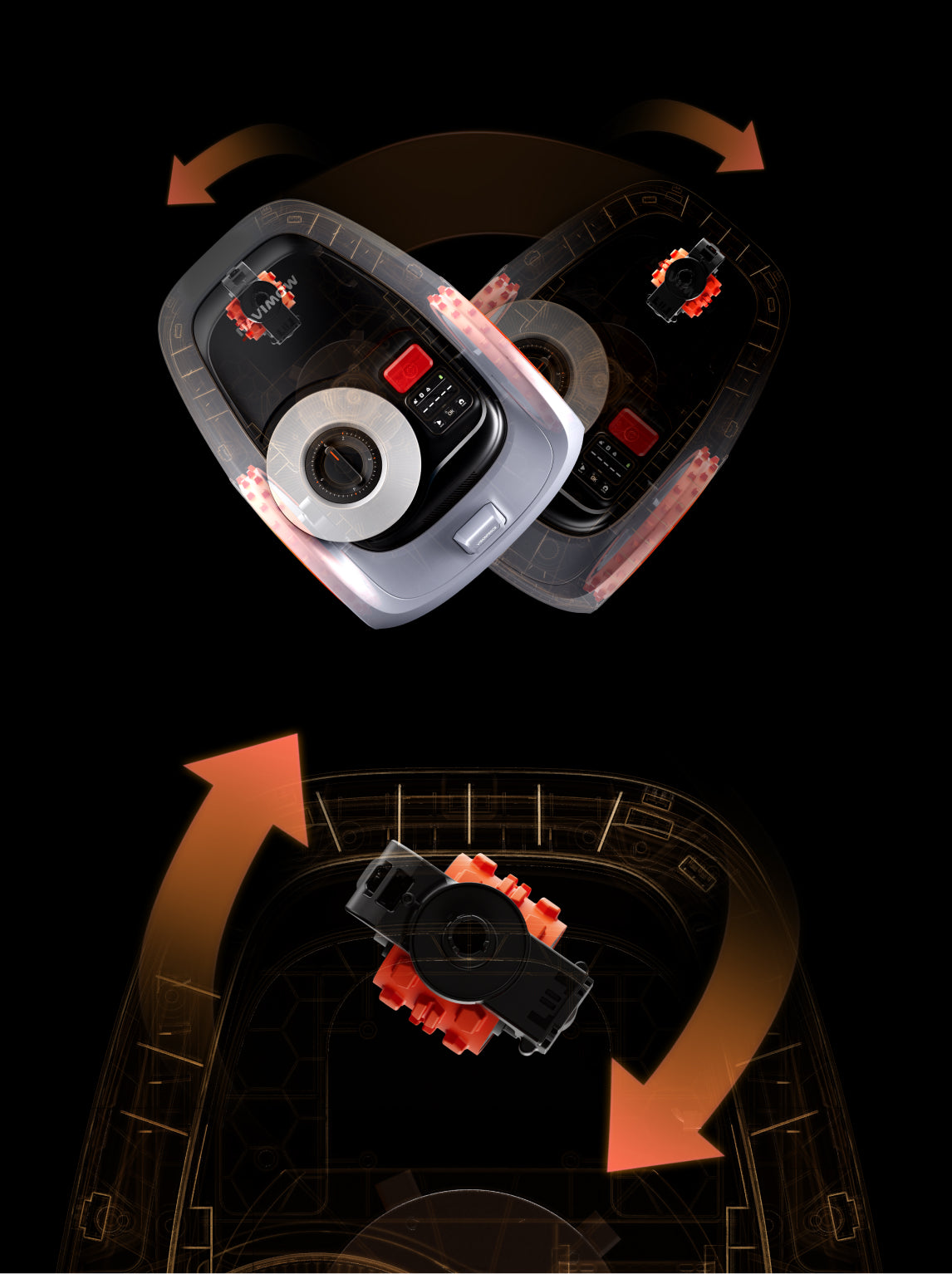
Similarly, the Navimow H2 series has Electronic Stability Control (ESC). It actively regulates wheels during turns to maintain a balanced center of gravity. Thus, even if there is a divot or bumpy area, the mower maintains its balance and doesn't lose traction.

Navimow mowers can work in uneven lawns, small ruts, divots, and bumps. They do not get stuck here during operation, which means users don't have to rescue them.
Powerful Wheel Drive
The reason Navimow mowers conquer difficult terrain is the powerful wheel drive. They are designed for all-terrain performance. Whether it's root-covered terrain, uneven stone path, or vertical steps in the middle of the lawn, they work without any interruption.

The powerful motor drives the mower and allows it to perform well on uneven lawns. Most importantly, some lawn mowers are equipped with the All-Wheel Drive (AWD). If one wheel falls in a divot, the remaining three wheels help the mower come out of it without any hassle.
For instance, the Navimow X4 series has AWD and dual suspensions. It can handle potholes, bumps, gravel paths, waterlogged lawns, and almost any surface.

Steep Slope Performance
Because of the powerful drive, balanced center-of-gravity, off-road wheels, and suspensions, Navimow mowers can perform on steep slopes.
The Navimow i2 AWD, i2 LiDAR, and H2 series work on slopes up to 45% (24⁰), while the Navimow X4 series handles steep slopes up to 84% (40⁰).

The mowers maintain exceptional traction on slopes. They can do lateral and diagonal movements on inclined surfaces. They can also move in reverse and do in-place turns on hills.
The integrated ESC (Electronic Stability Control) system continuously adjusts wheel behavior to maintain straight and stable motion on any incline.
The Navmow H2 series is also equipped with Terrain Adapt, which analyzes the whole lawn and divides your lawn into optimized zones and plans the ideal route, even on slopes.

Reliable Satellite Signals with NRTK
Navimow robot lawn mowers are equipped with Network RTK. It is a network-based GNSS positioning service that does not require any local antenna or base station. It accesses GNSS signals via internet connectivity and offers inch-level accuracy.
The notable part is reliable positioning. It is compatible with multiple certified Network RTK providers. Which means the mower automatically connects to the nearest and strongest signal source. It offers optimal coverage and consistent accuracy.

Because of multiple sources, the mower doesn't lose signals. If one fails, it connects to the other. That's the reason it can work under dense tree canopies, narrow passages, and open terrain.
The best part is that it delivers exceptional versatility across diverse environments. It works in constantly changing conditions, so you don't have to worry about geographical constraints and infrastructure limitations. It works everywhere and offers precise positioning.
You only need to connect the mower to the application, and it's ready to work. The setup is quick and completely effortless.
Multiple Navigation Technologies
Another factor for reliable navigation of Navimow mowers is multiple navigation technologies. Other than NRTK, the mowers also use other technologies, such as Vision, LiDAR, and VIO (Visual Inertial Odometry).
Most mowers utilize Vision navigation technology. They have multiple cameras to visualize the lawn area. They know if there is an obstacle ahead or a lawn boundary. The camera scans the area and maps everything in real-time to create a visual layout of the property.

Similarly, the VIO (Visual Inertial Odometry) tracks the movement and orientation of the mower. It takes data from multiple sensors and helps the mower navigate in a challenging environment. Suppose there is no satellite signal, it takes frames through the camera and compares with its internal motion sensors to determine how far and in which direction the device has moved.
Navimow also offers LiDAR technology in some mowers. The Navimow H2 and i2 LiDAR have this technology for precise navigation. Using a laser, it scans your yard at 200,000 points per second. It produces a dense 3D point cloud without any blind spots. It captures every corner, edge, and contour for unmatched scene awareness.

It maps your whole lawn at 4X higher resolution than other LiDAR mowers and offers a 230ft long detection range. It also has a 50ms scan interval, which means it can react faster to immediate changes and obstacles.
Precise Mapping
Navimow mowers offer both auto and manual mapping to map the lawn with incredible precision. You can go with the auto mapping if your lawn has visible and closed boundaries, flat and well-defined edges (no sharp slopes). It precisely maps every corner with perfection.
But if your lawn area is unclear and has uneven edges, manual mapping is the best choice. You can precisely map everything in no time. It's just like moving an RC car around the boundaries. Once the lawn is precisely mapped, the mower will never get stuck.

Users can also map non-mowing areas or off-limit islands. They can map islands like flowerbeds and swimming pools with the app, and the mower will never go to that area.
Advanced Obstacle Detection
The VisionFence™ of Navimow mowers takes obstacle detection to the next level. It uses multiple cameras to cover a field of view up to 360⁰. Thus, the mower sees obstacles in every direction.

With AI-powered obstacle detection, mowers can instantly detect obstacles from far away. They reroute in no time and maintain a safe distance. For instance, the Navimow X4 has a detection range of 16ft. Once it detects an obstacle, it reroutes within 0.1 seconds and maintains a 3.3ft distance while mowing.
Whether it's animals, everyday obstacles, or anything else, the mower detects them in real-time. Not only does it sense animals, but it also recognizes them. It can safely mow the lawn in the presence of pets and kids without affecting the mowing performance.

Most importantly, the mowers can work around suspended objects, such as trampolines, tables, and swings. If there is enough clearance, they mow under.
Mowers are also capable of mowing at night. They can sense obstacles with precision even in total darkness. And this is what sets Navimow apart from other mowers.

Anti-Clogging and Easy Cleaning
To deal with clogging issues, some mowers like the Navimow X4 and H2 series have the anti-clogging disc. The disc prevents grass clippings from getting into the blade disc and ensures smooth operation.
Moreover, it's also easy to clean the tires and blade disc. Mowers are IP66-rated, so you can take a hose and rinse them in no time. It helps prevent clogging of the blade and tires without much hassle.

Final Words
Robot lawn mowers get stuck in the middle of operation because of uneven terrain, loss of satellite signal, excessive slope, mapping problems, and various other issues. We have discussed these common reasons in detail and shared what lawn owners can do to avoid the mower getting stuck.
However, a better option is to upgrade to a mower that addresses these issues with the latest technology and features. Navimow robot lawn mowers are equipped with a powerful drive, precise navigation technology, off-road wheels, optimal traction/stability technologies, precise mapping, and advanced obstacle detection. They work smoothly in difficult terrain and ensure optimal mowing performance without getting stuck.