Not everyone has a plain, even, and well-defined backyard. In fact, most lawn owners struggle with divots, bumps, and slopes. And that’s where the real struggle is.
Mowing a lawn is a laborious activity, and it gets worse if you have an uneven lawn. Moreover, if you don’t know how to mow an uneven backyard, you might end up ruining the mower, getting yourself hurt, or damaging the turf.
We are here with a complete guide on how to mow an uneven backyard. It will help lawn owners mow their bumpy and inclined lawns without harming themselves or their property.
1) Inspect the Yard
If you have an uneven yard, the first thing you need to do is inspect it before mowing. This is what professionals do before every mowing task. You have to be familiar with your lawn terrain to mow it the right way.
Walk in the yard and look for hidden rocks, tree roots, holes, bumps, steep slopes, and everything. There could be new holes and dips because of raccoons, moles, skunks, dogs, etc. Other than that, you should look for sprinklers, metal pipes, or anything that gets in the way.
Get rid of some obstacles, like small rocks, toys, pine cones, fallen branches, etc. Clear the area as much as you can. Do not underestimate small objects, as when they are hit by the lawn mower blade running at 3,000 RPM, they can cause an injury. In fact, projectile injuries (rocks/sticks) cause 15,000 ER visits per year.

You can divide your lawn into the plain area, the less uneven area, the slopes, and the risky bumps and dips. By doing so, you know where to go first and where to be extra careful. The plain area is the simplest and easiest to mow. Then, you have a slightly more difficult area that is a bit uneven. You can still mow on slopes with extra care, but the risky bumps and dips should be cleared without using a mower.
Identify the difficult spots in your lawn, such as deep dips, steep slopes, large bumps, etc. You may mark these areas. You can choose to mow less risky areas with a mower, and if the areas or portions are too difficult, you can use a string trimmer. It’s better to avoid mowing areas that are too dangerous.
Keep in mind that if the blade touches an immovable object, like a rock or tree root, it could damage the engine. It spins at an extremely high speed, and when it hits such an object, it could bend or snap the crankshaft, crack the aluminum engine block, or shatter the flywheel key. And you might need to purchase a new mower. Thus, it’s better to mark such spots and stay away from them while mowing.
2) Choose the Right Mower
You have three common options: Push Lawn Mower, Self-Propelled Lawn Mower, and Riding Lawn Mower. All of them have certain limitations and a standard operating procedure.
Mowing a plain area isn’t difficult. You can use any kind of mower there. But when it comes to dips and bumps, everything changes.
Push Lawn Mower
If you have a push lawn mower, it will be very difficult to drive it over a bump and control it when it suddenly goes into a dip.
You have to exert pressure and put in more effort, which is the reason it is only advisable for a small plain area with minimal obstacles.
Suppose it goes into a dip and the front wheels get caught. It won’t be easy to push a 60 lbs mower and take it out. And never think about mowing on a slope using a push mower.

Self-Propelled Mower
A self-propelled mower is definitely a better option for bumps and moderate slopes. It has an internal transmission system that drives the mower automatically. You don’t have to push it.
Rear Wheel Drive (RWD) mowers are perfect for hills and bumps. The reason is that when they try to climb, the weight shifts to the rear wheels, which offers better traction.
All Wheel Drive (AWD) mowers are the best for uneven lawns. All of their wheels are powered, so they can pull the mower from divots and ruts. You don’t have to lift the mower handle or try to take it out with force.
If your lawn has bumps, frequent dips, and hills, you should go with a self-propelled mower.

Riding Mower
Riding mowers are extremely powerful, but at the same time, they are quite heavy. They have their own shortcomings along with advantages.
If you have a riding lawn tractor, you can use it on normal slopes. They have steering control in the front that you can control like a car. They are easier to handle on slopes and won’t slide sideways. You can safely move them up and down the face of a hill to prevent a side-rollover.
But they are not good for dips and bumps. Suppose you take a lawn tractor to mow a dip. The rear wheels are in a dip, while the front wheels are trying to climb. In this case, the mower deck will scalp the lawn. The reason is that the cutting deck is suspended in the middle, and it’s rigid. It does not adjust according to the slope. Moreover, there are also chances that the mower’s wheel might get stuck in a dip.

People also use zero-turn mowers in their lawns. They are great when it comes to bumps. You can control both wheels separately and pivot 180⁰ as well. They absorb small bumps and mow the area with perfection.
However, they are extremely dangerous for slopes. The reason is that they have caster wheels at the front that are free to move, and they steer with the rear wheels. If you try to drive them across a slope sideways, the front wheels will move downhill because of the gravity. Thus, the mower will lose traction and slide uncontrollably downhill. In the worst case, it could flip.
Zero-turn mowers are good for lawns with bumps. And they can handle slopes up to 15⁰. Do not mow steeper slopes with them.

3) Plan a Route and Adjust the Cutting Height
Once you have identified the obstacles, terrain, and difficult areas, you can plan your route. Now, you know how to mow different areas, which is why you can plan better.
Another important step is adjusting the cutting height. For an even lawn, you can pick any cutting height and get as low as you want.
But when you are cutting an uneven lawn, you have to keep the deck higher. The recommended deck height is 3.5 to 4 inches.
The primary reason for doing this is to prevent scalping. If the blade is too low and one of the mower’s wheels goes into a dip, there is a higher chance of scalping. The blade could hit the grass crown or roots and damage the turf. And the result is a brown patch that requires a long healing time.

But when the blade is higher, there is a buffer to prevent scalping. Suppose the tire rut is about 1 inch, and the blade height is 3.5 inches. In this scenario, the blade will cut the grass to 2.5 inches. It won’t expose the grass crown or damage the turf.
Simply put, the higher you keep the blade, the better it is. Moreover, it’s also good for aesthetic appeal. When the grass is tall, the whole lawn looks uniform. It hides the unevenness and creates a smooth visual texture. But if you do it low, there will be visible bumps and holes.
4) Mow Less Uneven Areas First
You can start with the plain area if there is any, and then mow the less uneven area. It's an area with no extreme dips and bumps and no steep slopes. It’s slightly uneven.
For this area, you can use your self-propelled or zero-turn mower. Both will work great. A self-propelled mower with rear-wheel drive is an incredible option because of its versatility. Just try to go slowly on dips and bumps to have better control of the mower. If you go at full speed, the mower will start to bounce and cause uneven cuts. It could also go out of control.

On the other hand, a ZTR mower is fast and could be a good option if there are no steep slopes. It works well on bumps and dips and covers a vast area in minimal time.
Be careful in the area. You can go with the diagonal approach. If there is a sharp ridge or a deep tire rut, do not go straight. You will end up putting both wheels in the dip, which will cause the blade to scalp the opposite bank of the dip.
Handle these areas at a 45-degree diagonal angle. By doing so, only one wheel of the mower handles the uneven area at a time. If the front-left wheel is in the dip, the front-right and rear wheels will be on stable ground. It will keep the blade a bit higher than the ground and prevent scalping or gouging the area.
Mow on Slopes
Mowing slopes is a bit difficult because there are chances of rollover, slipping, and various mower-related injuries.
Self-propelled mowers can handle slopes well. You can mow on slopes that are 15⁰-22⁰. Do not mow anything steeper, as it creates a severe rollover and slipping risk.

Always mow across (horizontally) the slope. If you try to push the mower straight up a steep hill, it can slide back towards you. You could end up injuring your feet or legs because of the blade. And if you try to come straight down, you could slip and end up in the path of the mower. That’s why you should never go up and down, as there is a chance of the mower rolling back onto you or tipping backward when you lose control.
You can safely mow across the slope. If the mower loses traction and slips, you will slip parallel to it. It’s much less severe than colliding with the mower.
If you are using a riding mower on a slope, never mow horizontally. While riding the mower sideways, the high side of the mower becomes light, and the weight shifts to the lower side. Therefore, it can tip over when it loses balance. It also results in severe injuries.
Always drive up and down (vertically) when using a riding mower. It gives your mower control, and there is no chance of tipping over. Keep in mind that even in the case of riding mowers, you should not mow slopes steeper than 15⁰.

5) Use a String Trimmer on Deep Dips and Bumps
Often, you will come across extremely deep dips and bumps that are difficult to handle. Your mower might get stuck while going through it. Secondly, you are also putting yourself at risk.
In such cases, the best option is to use a string trimmer. With this, you can cut the grass easily. It is a safe option for places where using a mower isn’t possible. You can use it around tree trunks, deep ruts, and high bumps. It can also work on steep slopes where normal mowers fail.
With a string trimmer, you can cut the grass as much as you like and even clean the edges. It’s a versatile tool, but you might have to learn how to handle it. Once you master it, it will be a go-to tool for difficult areas and edges.

Get an AWD Robot Lawn Mower and Get Rid of the Hassle
We have discussed how difficult it is to mow an uneven backyard. You have to be extra careful and mow every area with the appropriate mower and the right technique. Still, there are chances of damaging the lawn and getting yourself hurt.
The best option for an uneven lawn is an All-Wheel Drive (AWD) robot lawn mower. It will take care of all the uneven areas on its own and offer incredible results. Not only does it save time, but it also keeps you safe from accidents and injuries. You can automate lawn mowing, and you will never have to worry about it.
You can go with the Navimow X4 series. It’s a powerful AWD mower with Zero-Turn to dominate on every surface and conquer any lawn. Because of the AWD and dual suspensions, it can easily work on uneven lawns. Whether it’s border curbs, potholes, gravel paths, pitted surfaces, or waterlogged lawns, it offers exceptional performance on rough terrains.

It has a 5:5 balanced center of gravity distribution that keeps the mower stable on slopes. That’s why the mower can handle steep slopes up to 84% (40⁰), which is impossible for traditional mowers and even most robot mowers. It is equipped with a patented Traction Control System that dynamically adjusts wheel torque to prevent slipping on low-traction lawns.

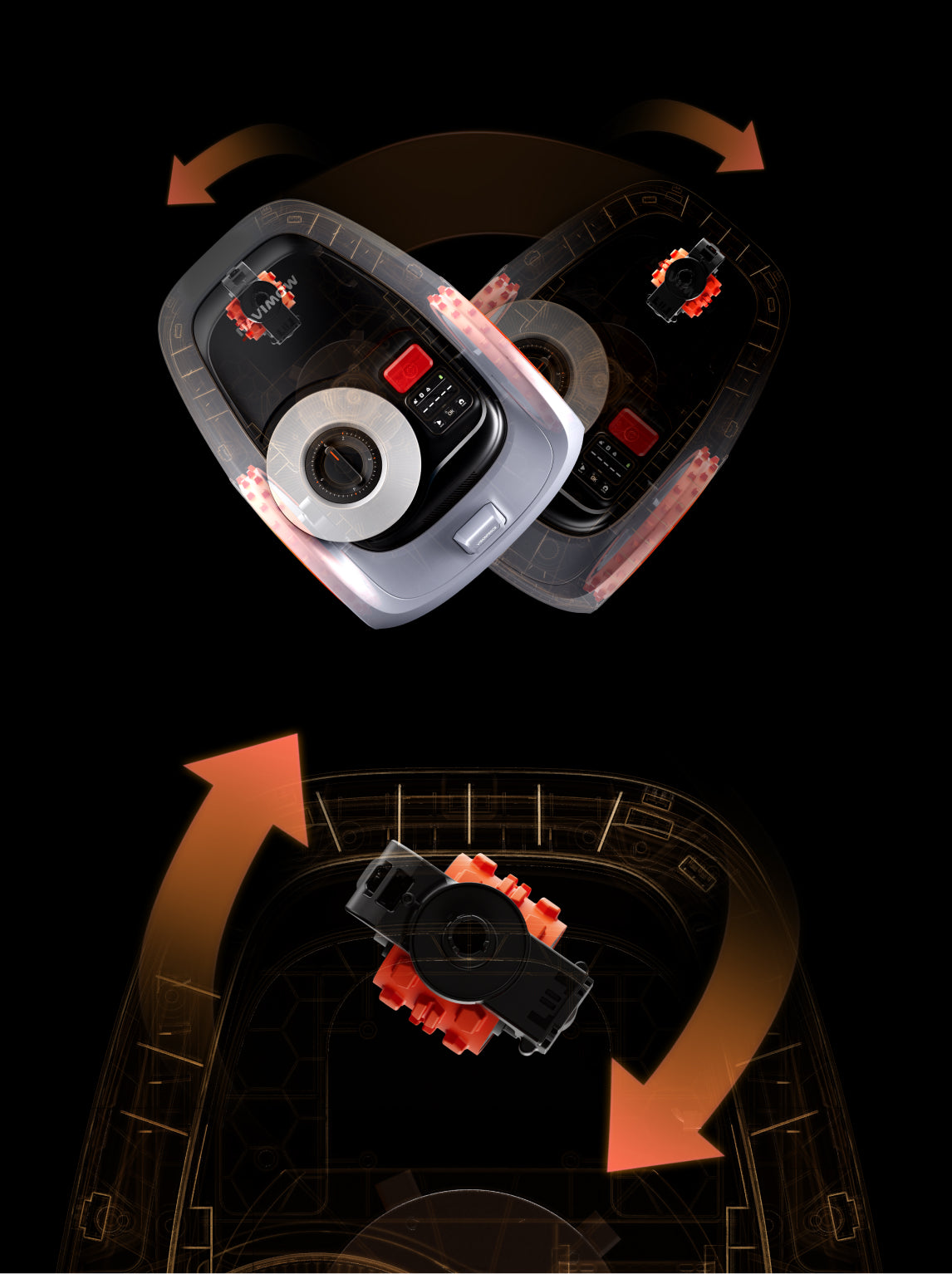
The notable feature is the Xero-Turn™. With this, the mower can make quick 180⁰ turns like a zero-turn mower. The revolutionary front-wheel steering system effortlessly switches between zero-turn and automotive-grade Ackermann steering. But it keeps a balance between agile steering and traction to prevent lawn damage.
The Navimow X4 is also superior in cutting performance. It’s equipped with the Adaptive Blade System. The blades automatically float over uneven ground to minimize scraping and lawn damage. With two 180W motors, it can handle thick, long, and tough grass without any hassle. And lawn owners can adjust the mowing height between 0.75 and 4 inches, which is ideal for uneven lawns.

Other than that, it offers reliable positioning with NRTK and vision technologies, perfect edge cutting, and advanced obstacle detection. It is an incredible mower that ensures optimal efficiency and precise mowing results.
Final Words
Mowing an uneven backyard is a bit difficult. You have to identify the areas, select the right mower, and mow every part with extra care. Still, there are chances of damaging the lawn and getting yourself hurt. We have explained how to mow an uneven backyard with perfection and minimize accidents and lawn damage. Beginners can easily follow it and take care of their lawns.
However, the best option is getting a robot lawn mower, such as Navimow X4. It handles uneven lawns, saves you a lot of time, and offers precise results. You get a perfectly mowed lawn without any risk of getting hurt.