


You might have heard about the lawnmowing beast, ZTR Mower. For many lawn owners, it is a dream because of its immense power, incredible maneuverability, and extremely precise cuts.
ZTR mowers have a lot to offer, but along with some advantages, there are disadvantages too. Before you decide to buy a ZTR lawnmower, here is a complete guide on what it is, how it works, its pros & cons, and when you should buy it.
We will explain everything you need to know in this Zero Turn Mower guide. By the end of this article, you'll be able to decide if this is the right choice.
Zero Turn Mower Overview
Zero Turn Radius (ZTR) Mowers are a special kind of riding mower designed to make 360⁰ turns. You can rotate them or change their direction 180⁰ within their radius. And that's where its name, Zero Turn Radius, came from.
With that said, a ZTR mower can mow almost any kind of lawn, no matter how complex it is. Its turning feature allows it to mow around trees, bushes, slides, and other complex areas where normal mowers can't perform well.
These mowers are powered by an extremely powerful engine. They can mow thick and long grass at an exceptional speed that starts from 8 mph and goes up to 20 mph in commercial mowers. That's why they can cut grass 40% faster than different kinds of mowers out there.

How Does a ZTR Mower Work
ZTR mowers can turn 360⁰ and maneuver better than other mowers, but the question is how? Before getting into that, it's better to understand its parts and how it operates.
When you look at a ZTR mower, you will see two caster wheels at the front and two large wheels at the back. Usually, the engine is at the rear to balance the weight. There are two levers or handles on both sides to control the steering system.
A common riding mower, like a lawn tractor, has the steering wheels at the front and driving wheels at the back. However, a ZTR mower controls both steering and driving through the rear wheels.
It has a hydrostatic transmission system that uses a fluid to transmit the engine's power directly to the wheels. And that's the reason you can precisely control the speed of the mower without having any gears.
Both rear wheels have a separate power and control source. Which means you can separately control them and adjust their spinning direction and speed.
The front wheels of a ZTR mower are casters. They are not controlled through the steering system. They are free to move, so they move wherever the rear wheels take them.

A ZTR mower works by controlling the spinning of the rear wheels. It's just like a trolley in a shopping center.
If you spin both rear wheels, the mower will move forward or backward, depending on the spin direction. For left and right turns, you need to spin one rear wheel while keeping the other stationary or at a slower speed.
For instance, for turning a trolley to the left, you push the right side, while keeping the left side in its position. The same goes with a ZTR mower.
A ZTR mower is capable of 360⁰ or sharp turns because its rear wheels can be controlled separately, while the front wheels are free to move. You can control the spinning of the rear wheel to maneuver the mower freely on your lawn.
How to Use a ZTR Mower?
For a better understanding of how a ZTR mower works, let's see how you can use it.
Braking
When the levers are outward, it means the parking brake is engaged. And when you bring them into place by pushing them inward, the mower comes to the neutral position.
Keep in mind that there is no brake in the mower. To stop it, you have to bring both levers to the natural position.

Move Forward/Backward
You need to move both rear wheels in the same direction to move forward and backward.
For forward movement, push both levers forward. For backward movement, push both levers backward. The speed of the mower depends on how far you push the levers.
Turn Left/Right
If you want to turn a ZTR mower, you need to use one lever to move only one wheel. Remember that the right lever controls the right wheel, while the left lever controls the left wheel. When you spin only one wheel, the mower turns, while the second wheel stays in its place. Push the level subtly for a smooth turn.
For the left turn, push the right lever subtly. It will spin the right wheel. And for the right turn, push the left lever subtly, and it will spin the left wheel. In both these cases, you will have a divot in your yard under the wheel that's not spinning.
That's why it's recommended to use both levers to take a smaller turn. You can push one lever slightly forward than the other. For instance, to make a left turn, push the right lever forward along with the left lever. Just make sure the right one is slightly forward of the left one.
The Zero Turn
Now, the most important one is the zero-turn. For this, you need to engage both levers. Push one lever forward and one backward.
For pivoting left, push the right lever forward and the left lever backward. Both wheels will spin in the opposite direction to rotate the mower at its center point, and that's what we call a zero turn.

Types of Zero Turn Mowers
Based on Intended Use
Residential Zero-Turn Mowers: These mowers are suitable for lawns of 1-5 acres. They are powered by an 18-25HP engine. They are suitable for residential lawn owners who mow once in a while. It costs around $3,500 to $5,000.
Commercial Zero-Turn Mowers: Commercial mowers are more powerful and equipped with a 25HP+ engine. They are suitable for professional landscapers who mow large lawns every day. It contains robust parts and components that can handle heavy-duty tasks and continuous usage. They are meant for robust performance. These mowers usually cost around $8,000 to $20,000
Based on Design
Riding Zero-Turn Mowers: The operator sits on the mower. There is a dedicated and comfortable seat from which the user can operate. It is meant for high-speed mowing and extended periods. It's suitable for residential mowing purposes.
Stand-on Zero-Turn Mowers: These mowers are for commercial purposes. The operator stands on a sturdy platform at the back of the mower from where everything is clearly visible. Its maneuverability is exceptional because of its smaller length compared to riding mowers.
Walk-behind Turn Mowers: These mowers are meant for small residential lawns. They run slowly, and the operator has to walk behind. They have better control, which is why they are suitable for steep terrains.

Based on Power Source
Gas Zero-Turn Mowers: These are extremely powerful mowers with a gas engine. They are suitable for both residential and commercial lawns. Just fill the gas and use it as long as you want. They can cut dense and long grass and overcome any kind of terrain. That's why they are extremely popular.
Electric Zero-Turn Mowers: Electric mowers have a rechargeable battery. It has a limited run-time, so it can't be used for commercial purposes. However, for small residential lawns, it's a good option because of zero emissions, minimal maintenance, and quiet operation.
Advantages of a ZTR Mower
Incredible Speed and Efficiency
ZTR mowers are known for their speed. They can cut grass at 8-20 mph, no matter whether the grass is thick or long. Its powerful engine makes it 40-50% faster than standard lawn tractors. It saves you a lot of time and completes the job quickly.
It's an efficient mower not only because of its high speed, but also its large deck and quick turns. Its deck starts from 36 inches and goes up to 72 inches. Due to a large deck, it can mow a larger area at a time.
Secondly, it's easier to turn at the end of the lawn. You can make a quick turn and pivot the lawnmower instantly. It saves a lot of time.
Exceptional Maneuverability
A zero-turn mower offers unmatched maneuverability. It can turn 360⁰ and is able to work around the flowerbeds, bushes, trees, and other intricate lawn elements. It helps lawn owners mow every corner of the lawn.
If you have a ZTR mower, you don't need to use any other tool after mowing to mow around obstacles and difficult areas.

Excellent Cut Quality
ZTR mowers offer excellent cut quality. They mow grass with their sharp and large blade that rotates at a very high speed. It cuts grass evenly and with perfection. Thus, you never see ripped grass tips.
It gives your lawn an appealing finish that looks clean and attracts everyone's attention. Without needing any professional help, you can achieve the same finish on your lawn with the help of a ZTR mower.
Optimal Comfort
Mowing with a ZTR mower is much easier for the operator. It does not require any physical effort. The operator has to sit on a comfortable seat and mow the lawn in minimal time. You don't have to worry about operator fatigue or any issues. Its comfort allows you to use the mower for a long time and mow a large lawn without any pain or discomfort.
Disadvantages of a Zero Turn Mower
High Cost
The first disadvantage is the high cost of the mower. They are pretty expensive and start from $3,500. For many lawn owners, it's a huge amount to spend on lawn mowing. Apart from that, it requires gasoline, which means there is also a recurring cost.
In this amount, people can purchase multiple lawnmowers and even robotic lawnmowers. Affordability of such mowers is a real issue.
Steep Learning Curve
You only have two levers to control the mower. It looks simple, but it isn't. Mastering a zero-turn mower takes some time. Users need to practice and learn some techniques to achieve perfect cuts. For new users, it's quite difficult to control and maneuver. However, they learn over time.
Turf Tearing
A ZTR mower can tear the turf. It happens when you take a sharp or quick turn. During pivoting, it creates a divot or crescent shape on the grass. While turning the lawnmower, one wheel is at a higher speed, while the other is stationary or slow. And this is how the turf is torn. The grass in the area becomes dead as it damages the grass blades as well as the root system.
When you use a ZTR mower, most of your lawn looks exceptionally clean, but some areas are ripped. You witness a bare spot at such locations.

Soil Compaction
ZTR mowers carry a huge engine and heavy components. They have a massive weight, and your lawn has to bear it.
Due to the heavy weight of the mower, the soil compacts over time. And when it's severely compact, it hinders the exchange of air, water, and nutrients. Your lawn starts to suffocate and eventually dies.
When you are using such a heavy mower on your lawn, you must do lawn aeration properly and more frequently. It reverses soil compaction and helps your lawn recover from stress.
Before buying any lawnmower, you should have an idea of how much does a lawnmower weigh. Because it not only affects your lawn but also the mower's maneuverability, portability, storage, and other things.

Issues on Slopy Terrain
ZTR mowers can work on complex lawns, but they are not good when it comes to steep hills or high slopes. They can typically handle 10-15⁰, but if the slope is more than that, it becomes difficult for the operator to balance. The weight is not equally distributed at the front and rear sides, which is why it becomes unstable. It is quite risky on high slopes, so it is recommended only for even lawns.
Loud Noise
The noise of the gas is very loud. It disturbs everyone in the house and your neighbors. The noise level is usually 90 to 105dB, which means you need to wear hearing protection while using it. If you have a neighbor who complains a lot, you should avoid them.
The reason for its loud noise is the powerful engine, large cutting blade, and blade speed. Thus, you can't reduce its noise, and it's awful.
High Maintenance Costs
The cost of maintaining ZTR mowers is quite high, even higher than traditional gas mowers. Firstly, they have large engines and complex components, so it's not easy for a common lawn owner to maintain them. They often need to call lawnmower mechanics to keep the lawnmower running. Even to winterize the lawnmower, a professional is needed.
The cost of lawnmower parts is also high, and the care it needs takes its running cost to a very high level. That's why many lawn owners avoid getting a ZTR mower.

When You Should Buy a Zero Turn Mower?
Zero-turn mowers are not for every lawn and lawn owner. It's suitable only for the following cases.
Large Lawns
ZTR mowers are for large lawns. If you have a lawn over 1 acre, you can think about getting one. It's not the right option for small lawns that are around 0.25, 0.5, or 0.75 acres. For them, you can look for other lawn mower options. You can check out how much is a lawn mower.
Complex Yards
Normal lawnmowers can't mow the area around the trees, bushes, flowerbeds, and other obstacles in the lawn. For them, you need to use a manual tool or a string trimmer.
However, a ZTR mower is suitable for that. It can maneuver easily around obstacles and cut everything on its own.

Professional/Hobby
For professionals who mow large lawns every day, there is nothing better than a zero-turn mower. It is comfortable for continuous mowing and allows them to mow the lawn easily.
Secondly, lawn enthusiasts who like to maintain their large lawns on their own and mow with perfection should definitely go for a ZTR mower.
Save Time
A ZTR mower is fast and efficient. It can cut your lawn in minimal time because of its high speed, large blade, and quick pivoting. It's just a perfect lawnmower if you want to save time and mow your yard in one go.
A Better Alternative to Zero Turn Mower—Robotic Lawnmowers
The traditional zero-turn mowers are great, but not the best. We have already talked about their disadvantages, especially the damage they cause to your lawn, the loud noise, the frequent maintenance, and the high cost.
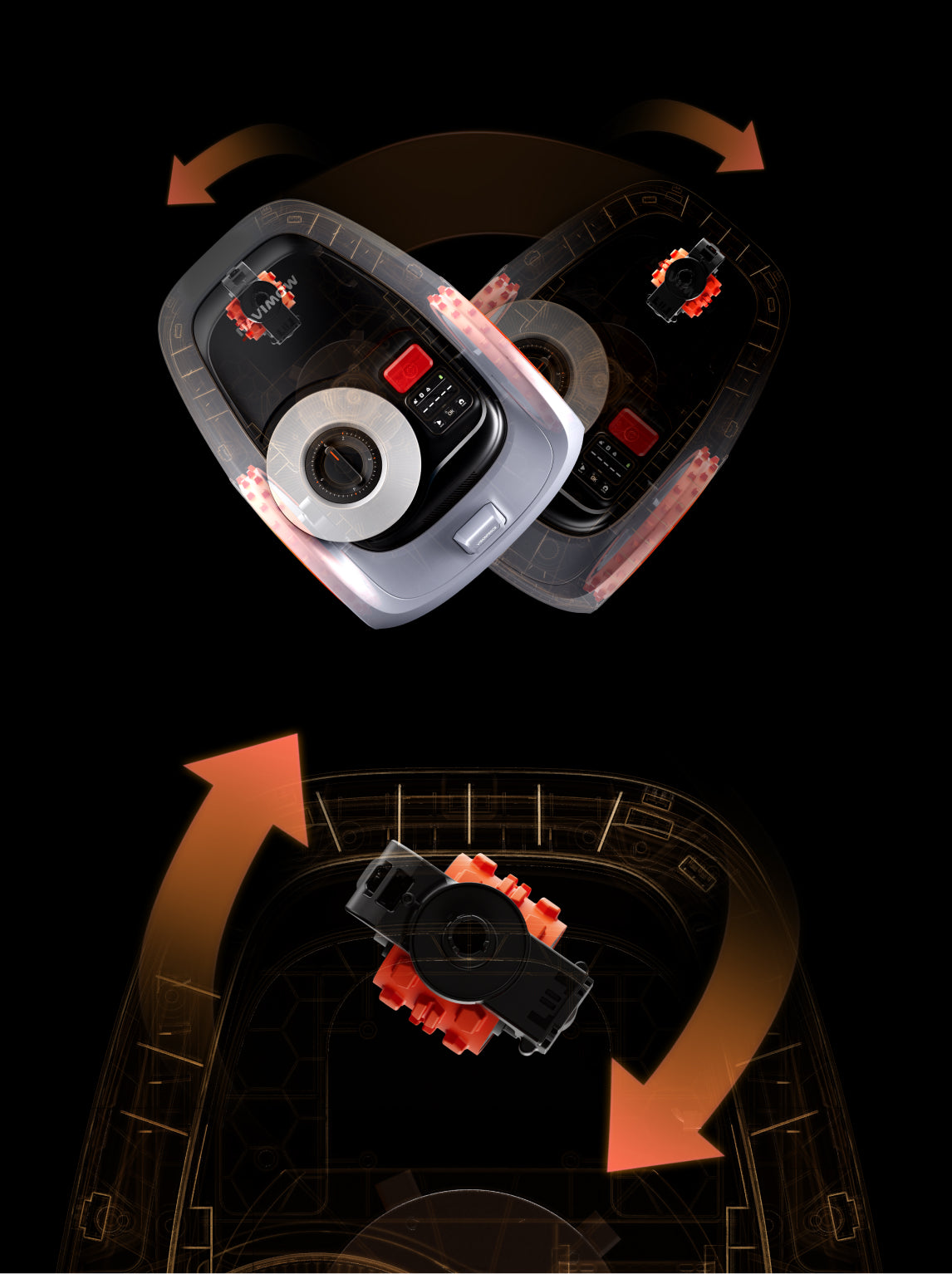
The Navimow X4 series addresses these issues. The mowers are equipped with Xero-Turn™ 4WD technology that conquers every terrain without damaging your lawn.
Firstly, it is an All Wheel Drive (AWD), unlike a traditional zero-turn mower, which has caster wheels. Thus, all the wheels are powered, and they offer incredible terrain domination. They are capable of working in all terrains, and even on slopes up to 84% (40⁰).

Its 5:5 balanced center-of-gravity distribution allows it work on steep slopes. It also has the patented Traction Control System (TCS), which prevents it from slipping. Thus, it can work where normal zero-turn mowers fail.
With the Xero-Turn™ technology, you don’t have to worry about turf tearing. These robotic lawnmowers can take a 180⁰ turn without harming your lawn.

They have a revolutionary front wheel steering system. For normal movement, it works as an automotive-grade Ackermann steering. When a zero-turn is needed, it is turned into a zero-turn steering.
To keep the turf safe, the Xero-Turn™ AWD system blends traction and agile steering. It moves the mower with precision and keeps everything in control. That’s the reason you don’t see any turf tearing or damage.

Robotic lawn mowers are lightweight. They do not compact the soil. Secondly, they are extremely quiet. The X4 series has a noise level of only 68 dB(A), which does not disturb your family members and neighbors.
They are also compact and can mow hard-to-reach areas without any hassle. Their dual suspension allows them to cover any type of terrain. Be it an uneven lawn, potholes, border curbs, or gravel paths, they mow everything with perfection. The best part is that the mowers of the X4 series can mow thick, long, and dense grass. They have a dual-disc blade system and powerful 180W motors.

The best thing about switching to robotic lawnmowers is that you don’t have to dedicate your time. They automate lawn mowing. You just have to set the schedule and mowing height. They save you from the complexity of zero-turn mowers, frequent maintenance, turn tearing, soil compaction, and other issues.
FAQs
Why do they call them zero-turn mowers?
They call them zero-turn mowers because they can turn within a zero radius. In simple words, they can rotate around their center, which allows them to turn instantly without any back-and-forth movement.
Is a zero turn a tractor?
No, a zero-turn mower is not a tractor. It's a type of lawnmower that can do 360⁰ turns. It steers and runs through the rear wheels, and there are levers to control the movements. On the other hand, lawn tractors are mini tractors that work like a car. It has a steering wheel, and the front wheel controls steering while the rear wheels drive the mower. They are more versatile compared to a ZTR mower.
Can you cut wet grass with a zero turn?
You can cut wet grass with a zero-turn mower. However, it is not recommended. It will damage your lawn and lead to soil compaction, equipment strain, and other issues. Check out our detailed guide, "Can you cut wet grass?"
Can zero turns handle hills?
Zero-turn mowers can handle slightly hilly areas. They can bear slopes up to 10-15⁰ °. If it is too steep, they can be unstable and unsafe. It's difficult to control them in a hilly area.
Why do zero-turn mowers cut faster?
They cut faster because of the powerful engine. They can move fast up to 8-20 mph. Secondly, they have a large deck and blade. They can mow more area at a time. Lastly, they can quickly turn and maneuver on the lawn and save the operator's time of the operator.




Share