Every lawn needs weed and feed to keep the grass healthy and get rid of weeds. But what confuses lawn owners is the timing.
It’s difficult to decide the right time without considering grass type, region, season, soil temperature, and other factors. If you apply at the wrong time, it might not bear any results or, in the worst case, destroy your lawn.
We have created this comprehensive guide on when to apply weed and feed. We have discussed the perfect time according to the type of weed, grass type, US region you are in, etc. By the end of this article, you will be able to decide when it’s the best time to apply weed and feed to your lawn.
Pre-Emergent Weed Feed Timing
Target Weeds: Annual grassy weeds (crabgrass, foxtail, goosegrass, and barnyardgrass) and selective annual broadleaves (common chickweed, knotweed, and spurge).
When to Apply
In spring, the soil temperature for the top 2 inches of soil should be 50°F to 55°F for 3-5 consecutive days. Another indication is forsythia bushes. When they are in peak bloom, it means it’s the right time to apply a pre-emergent weed and feed. Once you apply it, it does not let crabgrass grow.
The secondary window is late August to September. The soil temperature is around 70°F. After application, it targets winter annuals like annual bluegrass and henbit.
How It Works
Your weed and feed could have a pre-emergent as a weed preventer. Its purpose is to prevent weeds from growing. Once it’s absorbed by the germinating seed, it does not allow it to push its initial radicle (root) or shoot. That’s why the seed can’t absorb water and nutrients. When its internal energy reserves are completely consumed, it dies.
Keep in mind that it does not work on established weeds. It’s great for an established lawn after you've removed existing weeds. Moreover, if you use it on a new lawn, it will also treat grass seeds as weed seeds and will not let them grow.
As a pre-emergent, this weed and feed usually contains Prodiamine, Dithiopyr, or Pendimethalin. They are mixed with fertilizer content to promote grass growth while preventing weed growth.

Post-Emergent Weed Feed Timing
Target Weeds: Perennial broadleaf weeds (dandelions, white clover, dollarweed, plantain, ground ivy, and wild violet)
When to Apply
The air temperature has to be between 60°F and 85°F. If you go below that, it won’t kill weeds. And if you apply at higher temperatures, it will kill the grass along with weeds.
You can apply in late spring from May to early June. It’s a perfect time to deal with spring dandelions, clover, and plantain. The second window is early fall from September to October. The post-emergent kills perennial broadleaves when they are preparing for winter dormancy.
For better results, apply on wet leaves and plan it early in the morning. The granules stick to the weed leaves easily. After application, keep the lawn dry for 24 to 48 hours.
How It Works
Post-emergent weed and feed is for weeds that are fully grown and actively producing food. In most cases, when you buy weed and feed, it’s actually composed of post-emergent herbicides like 2,4-D, Meco-prop-p (MCPP), and Dicamba. However, you should confirm by reading the bag ingredients or specifications.
When the post-emergent chemicals are absorbed through the leaves, they rupture the plant’s vascular system (phloem). You will notice twisted stems, curled leaves, and yellowing. Within 10 to 21 days, the roots also die.
Weed and Feed Timing for Cool-Season Grasses
US Region: Northern US, Upper Transition Zone, Pacific Northwest
Common Grass Varieties: Kentucky Bluegrass, Tall Fescue, Fine Fescue, Perennial Ryegrass
The Spring Window
You can apply from late April to May. Do not apply too early because cool-season grasses wake up automatically using carbohydrates stored in the root system. Let it expand its roots first, and then apply weed and feed.
By this time, broadleaves like dandelions, clover, and plantain have developed large leaf surfaces. Therefore, you are ready to use a post-emergent weed and feed.
The Fall Window
This is actually the best window to apply weed and feed to cool-season grasses. And there are two reasons. Firstly, perennial weeds use their energy in storing carbohydrates, starches, and nutrients deep into their taproots. When you apply post-emergent at this time, it’s also absorbed in the taproots, which eliminates the weed from the base.
Secondly, cool-season grasses grow aggressively in fall. The nitrogen in the weed and feed helps the grass expand its roots for winter survival.
You can apply from September to early October. You should do it at least 4 to 6 weeks before the first frost in your region.

Weed and Feed Timing for Warm-Season Grasses
US Region: Southern US, Gulf Coast, Southwest, Lower Transition Zone
Common Grass Varieties: Bermudagrass, zoysia, St. Augustine, centipedegrass, bahiagrass
The Spring Window
The window is from April to May once there is 100% green-up.
Warm-season grasses take more time to wake up from winter dormancy. They go completely brown in winter and enter the spring green-up phase in March. They slowly wake up from dormancy using the energy reserves in their roots.
You shouldn’t apply weed and feed in the early phase. Wait until the turf is 100% green and has been mowed twice. You have to find the optimal time between April and May, depending on grass condition. Usually, it’s mid-to-late April in the South and May in the transition zone.
The Fall Window
For warm-season grasses, you have to apply weed and feed early in the fall. You can aim for August to mid-September.
Late fall is discouraged because warm-season grasses prepare for winter dormancy when the soil temperature falls below 60°F. If you apply nitrogen at this time, it will force top growth, and these succulent vegetative shoots will burst in the first winter freeze. It will damage the crown and kill the grass.
You should plan weed and feed application 8-10 weeks before the first frost.
If your lawn contains St. Augustine and Centipedegrass, you must avoid 2,4-D. It will also kill the grass along with weeds. For such sensitive grasses, you can opt for Atrazine-based weed and feed. Apply it when the daytime temperature is below 85°F.
|
Grass Type |
Varieties |
Spring Timing |
Fall Timing |
|
Cool-season |
Kentucky Bluegrass, Fescues, Perennial Ryegrass |
Late April-May (After 2-3 mows) |
September-Early October (4-6 weeks before hard frost) |
|
Warm-season |
Bermudagrass, Zoysia, St. Augustine, Centipedegrass |
April-May (After 100% green-up) |
August-Early September (8-10 weeks before first freeze) |
When You Should Never Apply Weed and Feed
Avoid applying weed and feed in the following scenarios.
Newly Seeded or Sodded Lawns
A weed and feed could be disastrous for your new lawn. Instead of protecting the new grass from weeds and giving it nutrients, it will kill the turf.
Suppose you have recently seeded the lawn, and the seedlings are in the growth phase. They aren’t mature enough and don’t have physical defenses to resist synthetic growth auxins present in post-emergents. The young grass will absorb chemicals just like weeds and will die before it can grow mature. Do not apply weed and feed until you have mowed the lawn at least 4 times.
Once you have applied weed and feed, you can’t overseed the lawn. The pre-emergents present in the top half-inch of the soil remain active for 12 to 16 weeks. They kill any sprouting seed, whether it's grass or weed.
If you applied post-emergent weed and feed, you still need to wait 3 to 4 weeks or maybe more for overseeding. The post-emergent components will harm grass seedlings and will never let them grow.

During Extreme Heat/Drought
Mid-summer is the worst time to apply weed and feed. Here are three primary reasons.
First, weed and feed contains granular fertilizer, which is actually mineral salts. During mid-summer, temperatures are around 85°F to 90°F. Because of high heat and drought, the soil dries rapidly, and the fertilizer pulls moisture out of plant cells and causes fertilizer burn. Within 48 to 72 hours, the grass will die.
Second, during heat stress, the weeds and grass close their leaf pores to prevent water loss. If you apply weed and feed, the post-emergent herbicide will only sit on the leaves. It won’t be transferred to the roots to eliminate the base. The leaves will be affected, but the weed will regrow in a few weeks. Simply put, the herbicide will not show the desired results.
Last, when the temperature is above 85°F, the synthetic auxins in the post-emergent begin to volatilize. They are transformed into gas and drift from the target area. They spread across the yard, such as flower beds, shrubs, and other parts of the lawn, and cause severe damage.
On Dormant or Frozen Turf
When the grass and weeds are dormant or frozen under a blanket of snow, there is no point in applying weed and feed.
The grass in the lawn, whether cool-season or warm-season, does not actively pull water or macro-nutrients from the soil when it’s in dormancy. Its metabolism has shut down for the period. If you use weed and feed, the fertilizer in it will stay in the soil and will run off to storm drains because of rain, melting snow, and spring thaws. It will contaminate the water and is bad for the environment.
Similarly, weeds cannot process post-emergents when they are dormant or surviving in freezing conditions. They will stay on the soil and break down from ultraviolet light or be washed away. Therefore, weeds remain unharmed.

Immediately Before and After Mowing
Never apply post-emergent weed and feed after mowing. Post-emergent broadleaf weed killers are absorbed through leaves, and when you mow, you remove most of the leafy area. That’s why post-emergent falls more on the soil (where it’s inactive) compared to leaves. Wait for two days after mowing. Once the weeds have pushed fresh leaves, you are good to go.
You can’t apply weed and feed before mowing either. When you run a mower after applying it, it destroys the whole treatment. Because of the mower’s suction, the granules end up either on the soil or in the mower’s bag. They will also stick to the mower’s wheels and body. You should wait at least 48 hours after applying weed and feed. Once it is fully absorbed, you can mow the lawn.
More Than Twice a Year
Do not apply weed and feed more than twice a year.
Herbicides need weeks to months to break down. If you apply multiple times in a season, it will saturate the soil with synthetic auxins. It also affects grass development and makes your lawn thin and unhealthy. Even if you try to overseed any area, new grass won’t grow or will die because of excessive herbicides.
Healthy soil contains a balanced ecosystem of mycorrhizal fungi, nitrogen-fixing bacteria, and earthworms. They automatically process the organic matter and aerate the soil. Frequent application of weed and feed destroys this ecosystem. It affects the soil pH, good bacteria & earthworm population, and beneficial fungal colonies. With excessive application, you will destroy soil health and grass.
High Wind Speed
If the wind speed is over 5 mph, do not apply weed and feed.
High wind speed drifts the granules to unwanted areas. They will fall on the flower beds, bushes, trees, and other places.
It will also result in uneven application. Any overtreated area due to wind will suffer from fertilizer burn. Weeds will also remain intact in undertreated areas.
Before Rainstorm
If you are applying weed and feed before a rainstorm, it will have no effect on the grass or weeds.
Granular post-emergent herbicides require 24 to 48 hours of contact on damp leaves. Any heavy downpour will flush the chemicals from the leaves. Similarly, the fertilizer content will also end up in the storm drains or local waterways.
It’s better to check the rain forecast. Ensure a 24- to 48-hour dry window after application.
How to Apply Weed and Feed Properly?
Select the Right Weed and Feed
Identify the weeds in your lawn. Here is our detailed guide on types of weeds.
You need to select a suitable weed and feed according to the weeds in your lawn and grass type. Make sure the content in the product won’t harm your grass.
Check the label of standard weed and feed products. You will learn where you can use them, the right quantity, and how they will affect your lawn.
Also, calculate the number of bags you need according to the lawn area and application rate.
Mow the Lawn
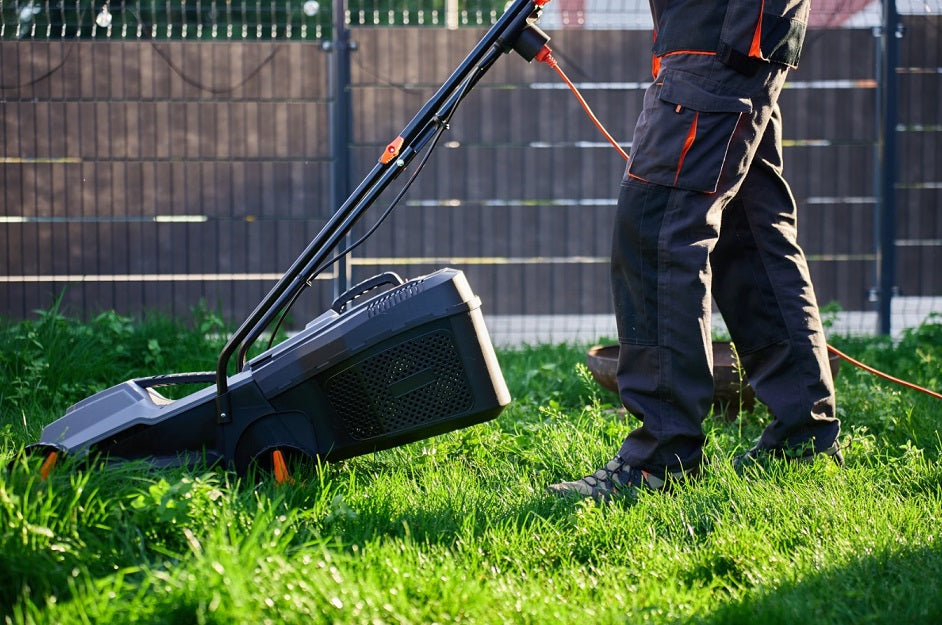
Mowing the lawn is recommended, but you need to do it 2 to 4 days before the application of weed and feed.
Schedule your robot lawn mower, and it will automatically mow the lawn and make it ready for weed and feed application.

Do not scalp the grass. Maintain the optimal height according to the grass type. Check out the best height to cut grass.
The grass will also heal in this period. It has open wounds, which could lead to excessive herbicide absorption.
Spread the Weed and Feed
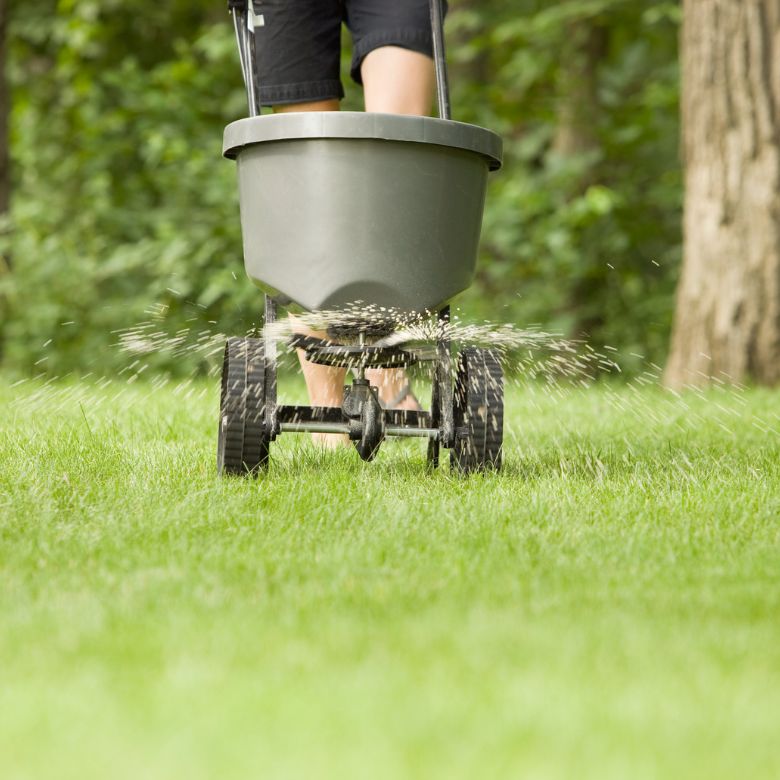
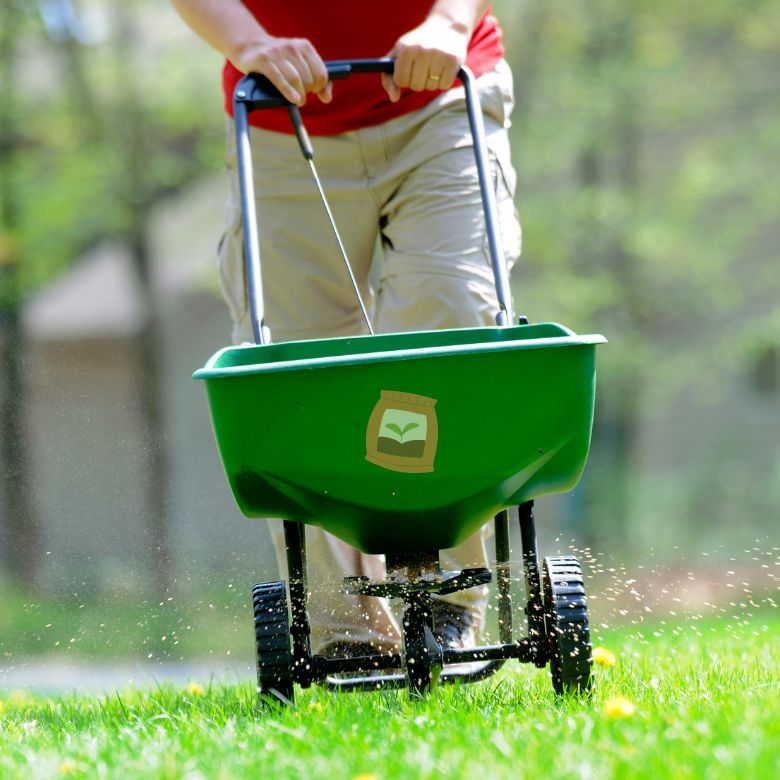
Now, you have to adjust the broadcast spreader. It’s better to set it to half of the recommended rate. This way, you can ensure every area is covered through a criss-cross technique.
Set the dial and walk in parallel lines from north to south. Once you have done that, load the spreader with the remaining half of the product and walk east to west. This time, you will be at a 90-degree angle to your first pass.
Make sure to walk at a steady speed. Going around 3 mph is recommended.
If some granules end up on the driveway, sidewalks, or other areas, blow them onto the turf. Otherwise, they will end up in the storm drains and pollute the environment. They also leave stubborn orange-brown rust stains on concrete and pavers.

FAQs
What time of day is best to weed and feed a lawn?
The best time of the day to weed and feed a lawn is early morning. The weeds are wet because of morning dew, and granules stick to the weed leaves and offer better results. Moreover, the temperature is lower, so the weed and feed won’t burn the lawn or volatilize.
Can I weed and feed twice in a month?
No, you should never apply weed and feed twice a month. Otherwise, there will be excessive fertilizer and synthetic herbicides on the lawn, which could burn the lawn or harm the grass and soil. Wait for at least 8 weeks and do not apply more than twice a year.
Can I weed and feed at night?
No, you should not weed and feed at night. Weeds close their leaf pores at night, so they cannot absorb the herbicide properly. Moreover, the fertilizer sitting on the wet grass overnight invites fungal diseases.
Do you water before or after weed and feed?
You should water the lawn lightly so that granules can stick to the weed leaves. If there is already morning dew, you don’t need to water, as there is enough moisture.
Should I mow my lawn before or after applying weed and feed?
You should never mow immediately before or after applying weed and feed. Mow 2 days before the application. And once you have applied, wait at least 4 days to mow.
Can I put down weed and feed after rain?
Yes, you can put down weed and feed after rain. Just make sure there is no new rain forecast in the next 48 hours, and the lawn is not waterlogged.
How long after weed and feed can I water?
You should wait 24 to 48 hours after the application of weed and feed. This gives enough time and allows the herbicide to fully absorb into the weed leaves. If you applied a pre-emergent weed and feed, you need to water the lawn immediately after application.