Weeds are the lawn owner’s nightmares that not only steal the lawn’s aesthetics but also rob it of water and nutrients, badly affecting its health.
As a lawn owner, you should be familiar with the types of weeds, how to prevent them, and how to deal with them to make your lawn healthy again.
Whether you are a beginner, hobbyist, or an experienced lawn owner, this comprehensive guide on types of weeds will help you understand your lawn better, identify weeds, and treat them the right way.
Types of Weeds Based on Physical Structure
Broadleaf Weeds
Broadleaf weeds are the easiest to spot and identify. They look different in your lawn and ruin the aesthetics.
They have broad, plain leaves with a visible net-like vein pattern. You will also witness some flowering in them. The size and structure of the leaf vary according to the variety.
All broadleaf weeds are Dicots, which means they sprout with two seed leaves. Some grow in a circular cluster of leaves, while some creep along the surface through runners. Common broadleaf weeds include dandelions, clover, chickweed, thistle, and henbit.
These weeds are the invaders in your lawn. Their flowers are the seed factories that spread the weed quickly. However, the best thing is that you can kill them without harming the lawn.
Grassy Weeds
Grassy weeds are monocots, which means they belong to the same botanical class as your turfgrass. They sprout from a seed with one leaf, which is long and narrow with parallel veins running from the base to the tip. They do not have the net-like pattern.
It’s difficult to spot them at a glance. However, if you look for leaves different from your turfgrass, you can easily find them. They are taller with different shapes and textures. Common grass weeds include crabgrass, goosegrass, foxtail, and quackgrass.
These weeds have the same DNA structure as the grass in your lawn. They share the same root structure and require the same nutrients. It’s actually bad news because it makes killing them a bit difficult. It’s extremely challenging to control them, and when you try to kill them, they will also kill the grass.
It’s recommended to prevent them from growing. For that, you can use a pre-emergent herbicide in the lawn. It does not let the weeds grow. The natural way to prevent these from growing is to keep the grass long, about 3.5 to 4 inches, to prevent sunlight from reaching weed seeds.
But if they grow, it becomes difficult to get rid of them. You can’t use the same chemical as for the broadleaf weeds because of the difference in biology. If there are a few, you can hand-pull them from the ground. But if there are too many, you have to be extremely careful with selecting a post-emergent herbicide. Non-selective post-emergent can kill the grass, so you have to opt for a selective post-emergent.
Sedges
Sedges are extremely difficult to spot in the lawn because they look similar to turfgrass. You have to look very closely and identify them through physical characteristics. They look like grass, but botanically, they are close to lilies.
While finding them, you should look for the triangular stem. There are three sharp corners, unlike the turfgrass. Secondly, they grow in a “V” or “Y” shape from the base, which can be easily distinguished.
Sedges are extremely invasive. They grow through rhizomes (underground runners). One mother plant can create a chain of 10+ plants. They grow quickly in a straight line and cover your whole lawn. Secondly, they produce “Nutlets,” which are tiny starchy tubers. They stay dormant in the soil for several years and wait for the rainy season to sprout.
If there are sedges in your lawn, do not think about pulling them. When you pull them, it signals the nutlets to sprout immediately. Eventually, by pulling one weed plant, you have five more in the coming weeks.
Normal herbicides usually do not work on sedges. The reason is that they have a thick wax layer that prevents herbicides from entering the leaf. You have to use a sedge-specific herbicide, which penetrates the sedge layer to kill the weed.
Keep in mind that sedges are stubborn. They take a week or two to die. But if you don’t see any results, you should apply the herbicide once more.
Types of Weeds Based on Life Cycle
Annual Weeds
Annual weeds complete their life cycle in one season or year. From germination to flowering, they undergo the whole process, so they have a shorter lifespan. They grow in thin spots, driveway edges, etc. They mostly cover the bare areas. Once the annual weeds have sprouted or grown, you should pull them out before they flower.
They can be divided into two sub-categories, Summer Annuals and Winter Annuals.
Summer Annuals are extremely common in lawns. They germinate in spring when the soil temperature is 55-65⁰F, just the same time when cool-season grass seeds grow.
They grow aggressively in summer and drop their seeds in the late summer or fall. They die automatically when you have the first hard frost in your lawn. To control them, you must apply a pre-emergent in spring and prevent sprouting. Common summer annuals include crabgrass, foxtail, and goosegrass.
Winter Annuals thrive when the lawn is in winter dormancy. They germinate in the late summer or fall. They stay green throughout the winter and flower in the early spring. They die in the summer heat. You must apply pre-emergent in the fall to prevent their germination. Common winter annuals include henbit, common chickweed, and annual Bluegrass.
Annual weeds have a specific season to thrive, but their seeds live longer, up to 10 years. They do not invest their energy in creating deep roots. Instead, most of its energy is utilized for seed production. They are the seed factories, and the seeds can grow anytime in the future.
Perennial Weeds
Perennial weeds are the most stubborn types of weeds. They do not die even in hard frost or extremely high temperatures. They survive in every condition. They can live for several years because of their biology. Common examples are dandelion, ground ivy, nutsedge, and quackgrass.
These weeds have deep taproots. They grow to extreme depth and store energy, which is the reason they survive. If you pull them out and remove 1 inch of the root, there are still several inches in the soil, so the plant grows back in no time.
They grow through rhizomes (underground runners) or stolons (above-ground runners). The underground runners expand in the soil and create a massive network. While removing the weed, if you miss one rhizome, the weed is still alive.
The stolons run above ground across your grass. They capture your grass like a cobweb, so you can’t remove them without harming the grass.
It’s quite difficult to get rid of them. Even if you pull them out, they grow back again. Whenever you mow them or pull them out, the plant immediately triggers the underground cells to sprout.
The only way to get rid of perennial weeds is to use a specific herbicide. But it takes too much time. The chemical is absorbed into the veins. Then, it moves along with nutrients and reaches the flowers, roots, etc. And when it reaches the taproot, the plant loses its ability to store energy and dies.
You can spray in the fall. The chemical needs time to work. However, it affects the ability of the weed to store energy as time passes. Eventually, it does not wake up in the spring.
Biennial Weeds
Biennial weeds are between Annual and Perennial weeds. They have a 2-year lifecycle. Common biennial weeds include thistle, wild carrot, common mullein, and burdock.
The first year, you see a circular flat cluster of leaves hugging the ground. Its height is quite low, but the roots underneath go deep into the soil. This year is all about storing energy. It produces sugars and stores them in its taproots. It stores enough energy to survive winter.
In the second year, the plant utilizes its energy. Firstly, it produces a tall and thick stalk, which is easily visible. It grows quickly. Then, the plant uses its energy to produce flowers and seeds. After releasing the seeds, the plant dies automatically. Along with it, its taproots also die, but the seeds it has produced are ready to ruin your lawn.
For controlling biennial weeds, the golden window is the first year. You can spray an herbicide on them. While pulling the nutrients for storage, the plant also pulls the herbicide and kills itself.
It’s a bit difficult to kill the weeds in the second year. They develop a thick skin that resists chemicals, and you can’t hand-pull them, as many have sharp spines.
Common Types of Weeds in the US Lawns
Dandelions
Dandelions are perennial plants that live for a long time and become an eyesore in your lawn. They are extremely common, and you might have seen them. They sprout in spring and thrive in the extreme heat of summer.
Their taproot is thick and goes up to 12 inches deep. It could spread in the soil to a depth of 6-16 inches. It not only stores massive energy but also makes it difficult for you to pull out. If you try to pull it out of the ground, the taproot remains under the soil, so the plant regenerates within a week or two. If you want to pull it, use a garden trowel and pull it out along with its taproot.
The problem with dandelions is that their flowers turn into puffballs, which can release up to 20,000 seeds. They travel miles through wind and bees, which is why they can invade your lawn.
You can kill dandelions by using a Systematic Selective Herbicide, such as 2,4-D. Spray it in the fall. The plant absorbs the chemical and carries it down to the bottom of its root.
The trigger for dandelion is the sunlight. So, if you cover the garden bed with mulch, it will reduce sprouting.

White Clover
White clover is a creeping perennial with a three-leaf pattern. Each leaf has a white “V” crescent, which makes identification easier. During flowering, they produce white-to-pinkish flower heads that attract bees.
It spreads via stolons, which is why it can quickly cover your lawn. It weaves itself into the grass and makes the area look dense.
It usually grows in areas where the soil is nitrogen-deficient. It’s capable of pulling nitrogen from the air, which is why it is called a nitrogen fixer.
Carry out a soil test to determine if the soil is nitrogen-deficient. Then, use an appropriate fertilizer, which will boost grass growth and reduce clover.
Keep in mind that clover has a waxy leaf, so normal post-emergent herbicides won’t work. Go for a special broadleaf killer that has Triclopyr or Dicamba.

Ground Ivy (Creeping Charlie)
Ground Ivy, which is also known as Creeping Charlie, is a perennial weed. It is from the Mint family, and its leaves and smell are also similar to mint. You will witness purple flowers and 4-sided stems.
It grows 4 inches tall, which isn’t much, but it could spread in width and go up to several feet. It can take over your lawn and hide the grass underneath. It usually grows in shade and moist conditions. So, if your lawn receives less sunlight or there are shady areas, it could grow there.
You can get rid of ground ivy with a special herbicide containing Triclopyr. The standard herbicide 2,4-D does not work on it. You can spray in the late fall, while the second-best option is early spring. When you see the purple flowers, you can spray right away.
You can prevent ground ivy by improving sunlight and drainage in the lawn. Avoid overwatering and puddles.
Common Chickweed
Common chickweed is a winter annual that prefers cool and moist conditions. It grows in early spring and late fall. You can easily identify it by its oval-shaped leaves with a pointy end. Its stem is covered with very fine hairs. It has white star-shaped flowers.
It grows close to the ground and reaches 6 inches in height. It forms a dense mat, which is the reason it covers a large area. The worst part is that it blocks sunlight from reaching the soil.
You can use a pre-emergent in the fall to prevent seeds from sprouting. If these are already grown, you can opt for a post-emergent. The standard broadleaf killers, such as 2,4-D or Dicamba, work well.
It does not have deep roots, so you can also pull it out of the ground. For future prevention, make sure the soil is not too wet and high in nitrogen. Improve the draining and do lawn soil testing to determine nutrient levels.

Henbit
Henbit is a broadleaf weed that grows annually. It’s also from the mint family, having a similar leaf shape with scalloped edges. You will also notice a purple color along the edges of the leaves. If you crush its leaves, you can smell a minty aroma. Other distinctive features are a square stem and reddish-purple flowers.
It usually grows from seeds and germinates in the fall. It hides under the grass in winter and appears in the late winter or early spring before your grass turns green. A single plant can produce up to 2,000 seeds that can fill your lawn with purple flowers.
You can pull out henbit before the seed heads appear on the flowers. For prevention, you can use a pre-emergent in the fall.
If it has already covered your lawn, do not use a post-emergent, as it won’t work. You should mow at the lowest height. It prevents the plant from forming more seeds. The best way to prevent henbit is to grow shade-tolerant grass. It covers shady areas and keeps the turf thick. So, the henbit does not grow in the middle of the lawn.

Crabgrass
Crabgrass is one of the most hated types of weeds. It is a summer annual grassy weed. It does grow for a short period, but a single plant can produce up to 150,000 seeds that stay dormant in the soil for a very long time. They are ready to sprout if there is a bare spot or you accidentally do scalping.
Identifying crabgrass is pretty easy. You will see long and wide grassy leaves growing in a star pattern. If you look closely, you will see a purple-red tint at the base.
It loves extreme temperatures and thrives in hot areas of your lawn. You will usually see it along sidewalks, pavement, and the edges of driveways.
In the spring, when the soil temperature is 55⁰F, you can apply a pre-emergent. You can also hand-pull these weeds and spot-treat them with an herbicide. If you want to prevent the seeds from sprouting, keep the grass longer to avoid sunlight.
Annual Bluegrass
Annual Bluegrass is a winter annual, which is commonly called “Poa.” It likes low temperatures and germinates when the temperature is 70⁰F in the fall.
Lawn owners commonly witness this weed in the spring. It remains green in winter when your grass turns brown. It cannot handle heat and dies when the temperature reaches 85⁰F.
It has a bright lime green color. You will see dense and low-growing clumps. You can easily identify it by looking at the greenish-white seeds. It has pyramid-shaped seed heads that dance in the wind and spread seeds everywhere in the lawn. A single plant can produce hundreds of seeds in a season.
Apply a pre-emergent in the fall. If you don’t do it at the right time, you will have weeds in the spring until they die in summer.

Goosegrass
Goosegrass is a summer annual weed. All the leaves originate from a central point and stay flat. It has whitish flat stems, but they are not as thick as crabgrass.
Usually, the grass dies due to poor water, air, and nutrient exchange in the compacted soil. But goosegrass thrives in such conditions. It grows in high-traffic and bare areas, such as the edges of driveways, sidewalks, etc.
The problem with goosegrass is that it’s not easy to kill. It is resistant to most herbicides and survives harsh chemicals.
There are two ways to prevent them. Firstly, you must ensure the soil is not compacted. Use a screwdriver and push it into the soil. If it does not glide easily to 2-3 inches and requires body weight or pressure, the soil is compact. You should do lawn aeration. When the soil is aerated, the grass becomes thick and dense, and does not allow the weed to grow.
Another option is to apply a pre-emergent in the spring. If the seed has already sprouted, you can opt for a pre-emergent containing Sencor or Pylex.
Foxtail
It’s another summer annual grassy weed that’s quite easy to distinguish. It has a fuzzy seed head that looks like a foxtail, which is the primary reason for its name. It grows upright and is visible from a distance if you skip mowing.
There are three varieties of foxtail weeds, including Yellow, Green, and Giant Foxtail, depending on the color and size. It’s actually harmful to the grass because it efficiently steals water and nutrients. If you have recently planted grass seeds, they will suffer from water and nutrient deficiency.
Use a pre-emergent in the spring. If they are already visible, use a post-emergent containing Quinclorac. You can also manage them through regular mowing. Mow them before they reach the seeding stage.

Quickweed
Quickweed is a broadleaf summer annual weed. The reason behind its special name is its extremely fast growth. Within a few weeks, it goes through sprouting to flowering, completing its life cycle.
It has oval leaves with toothed edges. You will also notice hair at the back. The flowers on these weeds are tiny. They have a yellow center surrounded by five small three-toothed petals.
A single plant can produce thousands of seeds. The specialty is that these seeds sprout immediately after falling; there is no dormancy period or waiting. That’s the reason they grow aggressively and can cover a massive area in your lawn in a short period.
Before the seeds appear, you can pull them out of the soil. The root system is shallow, so the weed will not grow again. You can also use a standard post-emergent herbicide to kill the plant.
As a preventive measure, use a pre-emergent in the late spring.

Yellow Nutsedge
Yellow nutsedge is a sedge that is extremely difficult to eradicate. It grows much faster than the lawn grass and becomes taller even if you mow once a week.
Like all sedges, it also has a triangular stem. It resembles turfgrass, but it is actually a perennial weed. It has a bright yellow-green color and yellowish-brown spikelet-like flower heads.
It produces underground starchy tubers called nutlets (like all sedges). You should not try to pull out the plant as it will trigger nutlets to break off and sprout new plants.
It usually grows when the lawn is overwatered or poorly drained. It loves moisture. If you want to get rid of it, reduce watering frequency and improve drainage. Let the soil of the area dry out. Then, you can use a sedge-specific herbicide to kill it.

Black Medic
Black Medic is a summer annual weed. It has three leaves with toothed edges. The center leaf has a longer stem than the other two. It has yellow flower clusters and a deep taproot. When the seed pods are at maturity, they turn black.
It grows low to the ground and thrives in soil low in nitrogen and prone to drought. It spreads out in a mat and chokes your grass. That’s why it’s better to get rid of it before it harms your grass.
It spreads through seeds, so before seeding, you can pull it out. If the seeds are already visible, you can opt for an herbicide. But keep in mind that most herbicides do not work due to waxy leaves, so use a surfactant for better results.

Broadleaf Plantain
Broadleaf plantain is a common perennial weed in lawns. It’s quite stubborn; even if you step on it, it won’t die.
It’s easily distinguishable. It grows in a circular cluster and has large oval leaves that usually touch the ground. There are parallel veins on leaves that are easily visible. In the summer, the weed sends up long stalks covered with green-brown seeds.
It grows in compacted soil. It has a massive fibrous root system that is not affected by soil compaction. Thus, you should think about aerating the area to improve water, air, and nutrient exchange.
When you mow the lawn, the leaves are often untouched. However, the stalks are shortened, so it reduces the chances of seeding. You can take the whole weed out of the ground along with the taproot using a trowel.
You can use a standard broadleaf herbicide to kill the weed. But as it is a perennial weed with a tough root system, you might need to apply again in the coming weeks.

Dollar Weed
Dollar weed is also known as Pennywort. It is a perennial weed with round, silver-dollar-shaped leaves and wavy edges. The leaf stalk is attached to the center of the leaf. You can call it a mini lily pad.
It grows when the soil is extremely wet. It could be due to overwatering and poor drainage. It spreads through rhizomes, and all the leaves are connected together to create a giant structure.
You have to control water and improve drainage to reduce the growth. Let the area dry, as they cannot survive in dry conditions. You can also use a herbicide to kill it if it is out of control.

Burweed
Burweed is also known as Stickerweed or Spurweed. It’s a winter annual weed that germinates in the fall. It has small, hairy leaves divided into narrow lobes.
It grows low and quietly in your lawn like a mat in winter. In the spring, it produces tiny, hard, spine-tipped fruits called burs. Once the burs are hard, they could harm your bare feet and your pet’s paws.
The plant dies in the summer heat, but these burs still stay there. That’s why you cannot wait. You have to kill the weed before the fruit hardens. You can use a herbicide to kill the existing plants. And use a pre-emergent in the fall.
Quackgrass
Quackgrass is a perennial grassy weed that looks like Tall Fescue. It is a fast-growing weed that covers your lawn quickly.
You can identify quackgrass through its light-green or blue-green color. It has sharp, white, straw-colored rhizomes that are extremely strong. Lastly, there are auricles, which are claw-like appendages at the base of the leaf blade. They clasp around the stem.
You should not think about pulling this weed. If you do so, the leftover root will sprout a new plant.
You can use a non-selective herbicide and spot treat the weed. After that, it leaves the area as a brown, dead spot. Then, you need to reseed the area to make it green again.

Green Kyllinga
Green Kyllinga is a perennial sedge. It looks like common grass but is extremely invasive. It grows in dense, thick mats. It has rhizomes and stolons, which is why it grows so quickly.
You will notice a triangular stem. It produces small, round, lime-green seed balls in summer. They usually grow in areas with high moisture. The area could be overwatered or poorly drained.
Use a sedge-specific herbicide to kill it. It is the only option as standard weed killers do not work on it.
How Regular Mowing Helps in Controlling Weeds?
Regular mowing helps in controlling weeds in various ways:
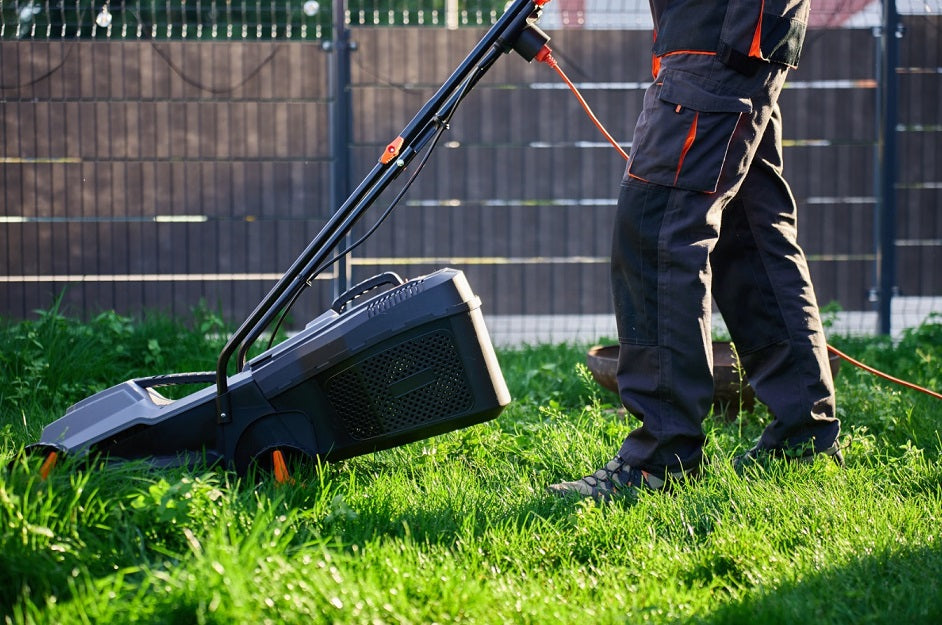
- You can mow the grass high and keep it at 3.5 inches to prevent sunlight from triggering the weed seeds. But make sure to follow the best height to cut grass according to the variety.
- When you mow regularly, you do not allow weeds to set seed. You physically remove the flower heads before they try to reproduce. It prevents new weed growth.
- By mowing the leaves regularly, you force the weed to divert its energy into producing new leaves. This way, its energy is wasted again and again. It cannot produce seeds, and when it starves for energy, it dies.
- Frequent mowing improves grass health and makes it dense. The grass grows sideways and leaves no space for weeds to grow.
There is no doubt that regular mowing is beneficial for your lawn and helpful in reducing weeds. However, mowing regularly is not possible for every lawn owner. Often, they miss mowing sessions, which allows the weeds to produce seeds and reproduce.
To solve this problem, you can opt for a robot lawn mower. You only need to set the schedule and mowing height, and the mower does the rest. Your grass is always maintained at the recommended height.
If you have a small lawn, you can opt for the Navimow i2 AWD series, which is suitable for lawns up to 0.25 acres. For large lawns up to 1.5 acres, the Navimow X4 series is ideal. Both mowers conquer difficult terrain with the All-Wheel Drive (AWD) and navigate lawns precisely with Network RTK.

Final Words
There are hundreds of specific weed species that ruin your lawn. As a lawn owner, you should know how to identify them in the first place so you can determine the right treatment. Fortunately, all these hundreds of varieties can be classified into a few categories, such as broadleaf, grassy, sedges, perennial, annual, etc. Understanding the types of weeds helps in finding the right killing method that does not harm your lawn.
We have explained the types of weeds based on physical structure and life cycle. Plus, we have shared some common types of weeds that are found in the US. Once you identify the weed, you can follow the recommended method to get rid of it.