Sometimes, the lawn is in such bad shape that you can't rescue it. For instance, the lawn could be overcrowded with weeds, full of bare patches, taken over by dead grass, etc.
In these cases, it's better to reseed the whole lawn instead of treating and seeding specific areas. It is also the only option when you want to change the variety of grass.
Reseeding is just like starting over and renovating the whole lawn. It requires a lot of effort, and you have to do everything correctly to achieve excellent results.
This article is a complete guide on how to reseed a lawn. We will help you choose the right time for reseeding and go step-by-step to turn your dead lawn into a lush, green space that is the envy of the neighborhood.
When is the Best Time to Reseed a Lawn?
Lawn reseeding is a major overhaul, and timing plays a crucial role in defining its success. You can't reseed at any time of the year because you have to consider if the seeds have the right conditions to grow, survive, and turn into healthy grass.
For cool-season grasses, the best time window is late summer to early fall, which is late August to mid-September. The reason is that these grasses grow aggressively in the fall. They wake up from summer dormancy and are ready to grow at the peak. Secondly, the conditions are favorable; the soil is still warm, and the air is cooling down compared to summer.

Moreover, the rainfall assists in keeping the seeds moist and increases the chances of growth. And there is minimal competition with weeds.
Another suitable window is early spring, but you have to ensure the grass can fully grow before summer. Secondly, it's also the time for weed seed germination, so you have to be extra careful.
Before planting cool-season grass seeds, you must make sure the soil temperature consistently stays between 50 and 60°F.
For warm-season grasses, the best window is late spring to early summer, which is May to June. These grasses tolerate the summer heat, and they grow aggressively in high temperatures. You can plant them when the soil temperature is consistently 65 to 70⁰F.
When you plant them in the late spring, there is enough time to have established roots when the peak growing season arrives.

Step 1: Get Rid of Existing Grass and Weeds
The first thing you need to do is get rid of all the existing grass and weeds in the lawn.
For weeds, you can use a post-emergent herbicide. If there are weeds all over the lawn, it is quite helpful in dealing with them. But if there are weeds at a few spots in the lawn, you can pull them out with your hands or spot treat them instead of using herbicide on the whole lawn.

After dealing with weeds, it's time for scalping. Mow the existing grass at the lowest lawnmower setting. It will help you get rid of the dead and unhealthy grass blades. After mowing, bag all the clippings and dispose of them properly.
Now, you have to do heavy raking to remove the grass roots and thatch layer. The best way is to use a power rake. It will put out everything and leave you with clean soil. But if the lawn is small, you can also use a manual dethatcher or rake.

It's necessary to remove the thatch layer as it won't let your grass seeds reach the soil. Rake heavily and expose the soil as if there was no grass before.
Lastly, get rid of the debris, rocks, roots, and every mess in the lawn. Get it ready for reseeding.
Step 2: Conduct Soil Tests
Before you reseed the lawn, it's advisable to conduct some soil tests. Your lawn has been suffering, and the culprit could be the soil.
When you do lawn soil testing, you get to know about the condition of the soil, and if there is any problem that you have to fix.
The first test is a pH test. Ideally, the soil pH should be slightly acidic to neutral, which means between 6.0 and 7.0. You can use a digital pH probe to test the soil pH. It gives excellent results. However, you can also get an idea through a DIY test kit.

If the soil pH is too low or too high, you need to adjust it. Otherwise, it will cause nutrient lockout. The fertilizer you provide to the lawn will be unavailable to the grass.
The second test is for macronutrients. You need to know how much Nitrogen, Potassium, and Phosphorus the soil contains. If there is any absurd ratio, you can correct it using an appropriate fertilizer.
DIY test kits also give you an idea of the soil macronutrients, but they are not accurate. The best way is to get the soil tested through a lab. It gives you the exact values of the nutrients along with some solutions. You can also get the values of micronutrients in a lab test report.

Another important factor is the Cation Exchange Capacity (CEC) of the soil. It is a measure of how many nutrients the soil can hold. If the CEC value of the soil is too low, the nutrients will wash away, and the grass will not thrive.
The only way to know the CEC value is through a lab report. If the CEC is low, you have to improve the soil components by adding manure, compost, etc. Lab reports suggest what you can add to the soil to improve the CEC value.
Here is our comprehensive lawn soil testing guide. Check it out to know how to collect a lawn sample and do DIY tests at home.
Step 3: Opt for Leveling and Soil Improvements
If your lawn has bumps and dips, it's the right time to fix them. You can level the whole lawn, and it not only looks aesthetic but also improves water drainage. Identify the highs and use a shovel to scrape the area. Use the excess soil in the low areas.
Through the CEC test, you might have an idea whether your soil is perfect or it contains a higher amount of sand or clay than usual. If the soil is fine, you can skip the following amendments.

To increase the CEC, you can add organic compost to the lawn to a depth of 1-2 inches. Spread it over the whole area. After that, use a garden rake to mix the compost with the existing soil to a depth of 2-3 inches.
Finally, rake the whole area to level everything. You can also use a lawn roller to lightly firm the soil.
Step 4: Aerate the Lawn
Your soil naturally has pores, and these are important for the air, water, and nutrient exchange. But over time, soil gets compressed, and these pores are eliminated.
When the soil is too compact, it doesn't let your grass breathe. It will strive for the nutrients and water. And this is when you need to do lawn aeration.
If you have done soil amendments in the previous steps, your soil won't be compact at all. But if you didn't do it, you should test for soil compaction. Use a screwdriver and push it into the lawn. It should glide easily, but if you need to add body weight or pressure to push it to 2-3 inches, it means the soil is compacted.
Core aeration is the best technique to relieve soil compaction. In this process, you remove plugs from the soil, and cavities are created. These holes reverse soil compaction and allow the soil to expand.

It's also beneficial for seeding. Because the holes improve the soil-to-seed contact. Secondly, the fertilizer reaches the roots easily.
For core aeration, water your lawn a day before. Then, use a power aerator to aerate the lawn. If the lawn is small, you can consider a manual core aerator.
After aeration, dispose of the plugs. If you want to leave them, just make sure to break them.
Step 5: Select the Seed
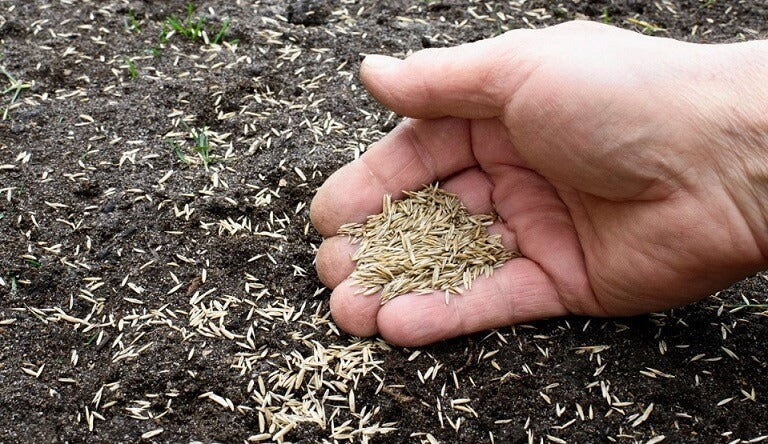
Now, it's time to pick the right seed for your lawn. First, you have to decide whether to go with warm-season or cool-season grass.
If you live in the Northern zone, where the climate is a bit cold, you should go with cool-season grasses. They thrive between 60⁰F and 75⁰F. They cannot handle high heat and remain green longer in the winter. When the temperature increases above 89⁰F, they enter summer dormancy.
For Southern regions, the best option is warm-season grasses. They thrive between 80⁰F to 95⁰F. They love high heat and grow aggressively in summer. Their weakness is low temperature, and they go dormant when the temperature drops below 55⁰F.

Once you have decided on a warm-season or cool-season grass, you can look at the varieties. Keep in mind that each grass variety has distinct characteristics. Some are shade-tolerant, while some bear high foot traffic. Some can handle drought, while some are perfect for dogs. You have to pick the right variety according to your lawn.
Check our Cool-season vs Warm-season grass to pick the right one for your needs. If your lawn receives too much shade, you can opt for shade-tolerant grass. If you own pets, check out the best grass for dogs.
Step 6: Calculate the Seeds
Once you know the grass variety to go with, you can calculate the number of seeds you need. Start by measuring the lawn area. If the lawn is big, split it into rectangles and add everything to get the total area.
Check the bag or instructions of the grass seed. It has the appropriate seeding rate, which is in lbs per 1,000 sq. ft. If the seeding rate is 8 lbs per 1,000 sq. ft. and the lawn area is 5,000 sq. ft., it means you need 40 lbs of seed.
Here is a simple formula you can use:
Amount of Seed (lb) = (Area (sq ft) / 1000) x Seeding Rate (lb per 1,000 sq ft)

Step 7: Spread the Seeds
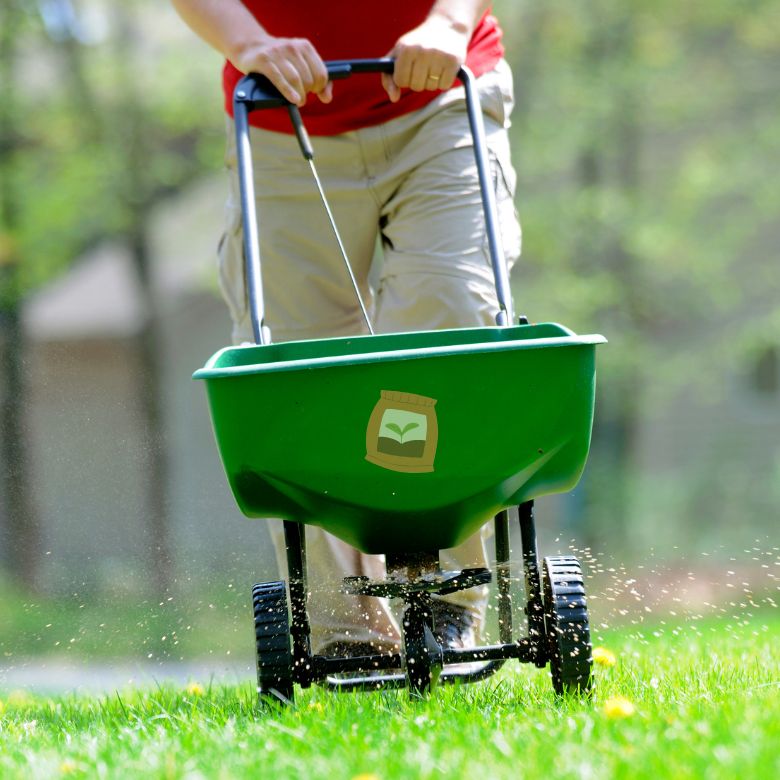
You should use a seed spreader to evenly cover the whole area. Add seeds to the bucket and adjust the dial. Run the spreader on the sidewalk to adjust the rate.
The best way to spread seeds is using the half-and-half technique. Spread half of the seeds while walking in horizontal lines. Then, spread the remaining half by walking in vertical lines. It allows you to cover every square foot twice.

Step 8: Add a Fertilizer
Seeds need a starter fertilizer. It slowly releases nutrients to the soil, which assists in seed germination and growth. The grass roots go deeper and lay the foundation of a healthy lawn.
We have already tested the soil. If your soil lacks any nutrients, you have a clear idea of what fertilizer to apply. Generally, starter fertilizers have a higher content of Phosphorus, which is the primary nutrient for root development.
Keep in mind that the fertilizer you choose should be safe for reseeding. If they contain a pre-emergent herbicide, except Mesotrione, it could kill grass seeds along with weed seeds. Check the label "Safe for Seeding" before buying.

Use a broadcast spreader to evenly spread fertilizer in the area just after seeding. Rake the area lightly to mix the fertilizer with the seed and soil. Then, use a lawn roller. It presses the seeds into the soil and improves the contact. The chances of germination increase to a great extent.
But make sure to use a light roller or water-filled roller. Do not use an extremely heavy roller as it can compact the soil. If you don't have a lawn roller, you can rent one.
Step 9: Apply Top Dressing
Top dressing is the protective layer for grass seeds. It does not let water or rain wash them away. It also protects them from birds.
Another benefit of top dressing is moisture retention. It keeps the seeds alive, improves germination, and ensures excellent results.
Peat moss is the best choice for top dressing. Spread a 1/4-inch layer in the lawn. Other than peat moss, you can go with weed-free straw or compost.

All these options have distinct benefits. Peat moss holds 20 times more water and is naturally weed-free. However, it is a bit expensive. Straw could have too many weed seeds, but it's quite economical and perfect for steep slopes. Compost is the organic choice, which provides nutrients and beneficial microbes to the soil.
While applying top dressing, you have to be extra careful. If you apply too little, it won't protect the seeds, and if you apply too much, it will block the sunlight. Aim for a light layer, and you should be able to see 10-15% of the bare soil.
Step 10: Ensure Proper Watering
Watering is the key to getting excellent germination rates. The grass seeds are extremely delicate. They need to remain damp in order to germinate. If there is any dry spell, the seeds will die in no time. And then, you can't do anything. Once seeds are dead, they won't germinate.
You have to ensure the top 1-inch of the soil stays moist no matter what. Initially, water 2-3 times a day but not deeply. Frequent and shallow watering is recommended.
Once the grass blades start to come out of the soil and reach 1 inch, you can reduce the frequency and water deeply.
For more details, check out how long to water new grass seed and how often to water grass seed.

Step 11: Mow Regularly
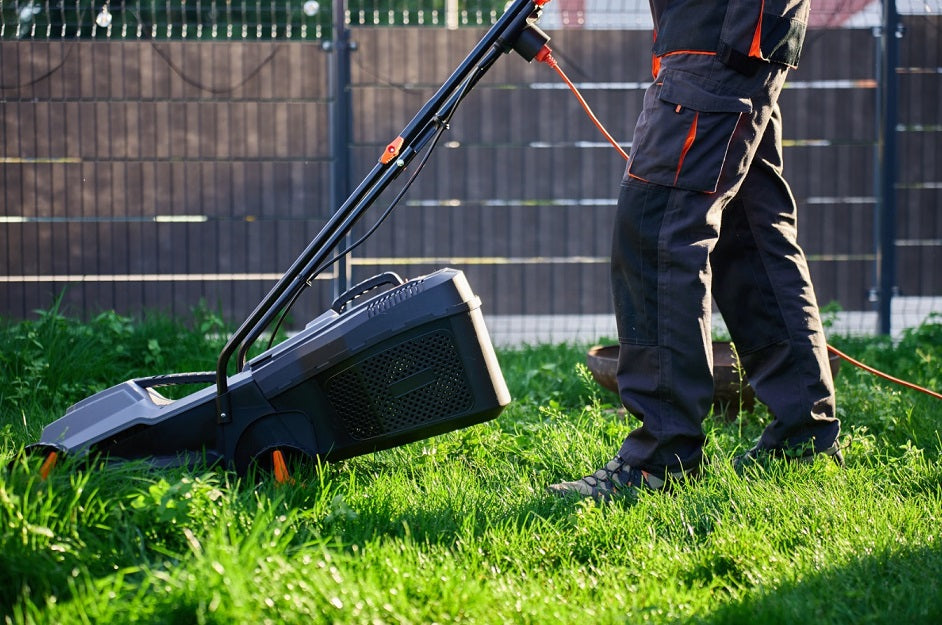
Initially, you shouldn't mow. Wait until the grass blades reach 3.5 to 4 inches in height. After the first mow, you need to maintain the best height to cut grass according to the variety. And it requires regular mowing.
Always follow the one-third rule for mowing. You should never cut more than one-third of the grass blades at once. Going against the rule means putting the grass under stress.
Before mowing, make sure the grass is dry enough to cut. The blades of the mower should be sharp to cut the grass tips cleanly. Dull blades rip the grass tips and make them vulnerable to diseases. Check out how to sharpen lawn mower blades.
Mowing regularly is the biggest hassle for lawn owners. They don't get enough time to cut the grass, which leads to overgrowth. To solve this issue, you should adopt a robot lawn mower. It precisely cuts every corner and edge of the lawn, and you don't need to do anything. It automates lawn mowing; all you need to do is set the schedule and mowing height.
The Navimow i2 AWD Series
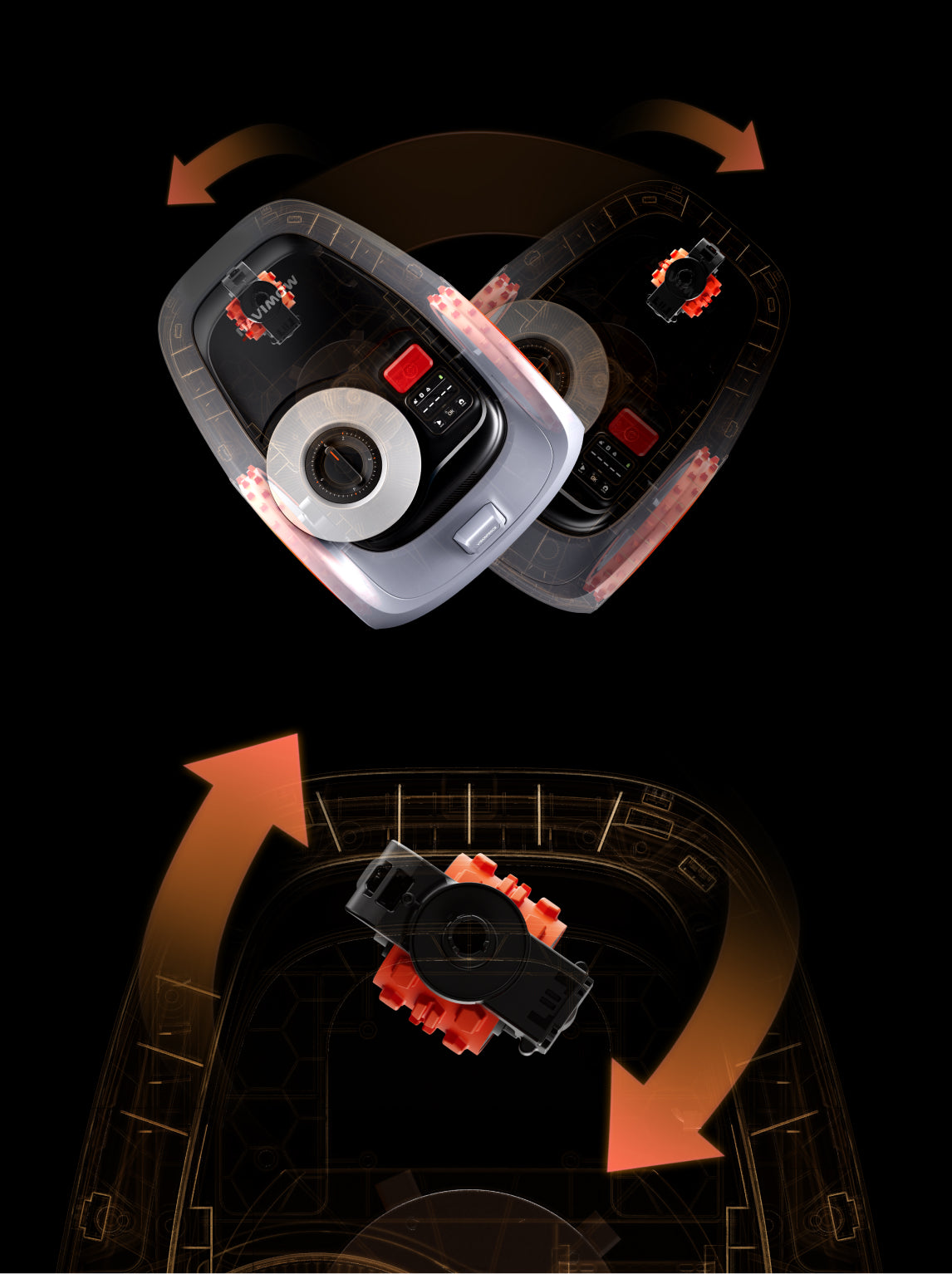
If you have a small lawn up to 0.25 acres, you can go with the Navimow i2 AWD series. It's a compact mower with All-Wheel Drive (AWD) to mow difficult terrains. It works on slopes up to 45% (24⁰). The Xero-Turn™ allows it to take 180⁰ turns in the lawn without damaging the grass.
It detects 150+ obstacles, including lawn objects, animals, and everyday obstacles. It reroutes within 0.1 seconds and maintains a 1-meter safety buffer. It automatically maps your whole lawn and precisely navigates the area with Network RTK.

The Navimow X4 Series
For large lawns up to 1.5 acres, the Navimow X4 series is incredible. It is the master of difficult terrains because of the All-Wheel Drive (AWD), dual suspensions, and patented Traction Control System (TCS). It works on waterlogged lawns, pitted surfaces, gravel paths, potholes, etc. With the Xero-Turn™ technology, it mows difficult and tight areas.
It's equipped with dual motors that can cut thick, long, and dense grass without any hassle. It also maintains the edges with the EdgeSense™ technology. It uses tri-frequency Network RTK, 360⁰ VSLAM, and Visual Inertial Odometry (VIO) to navigate precisely in large lawns. It automatically maps the whole area, while the GeoSketch™ allows you to edit real-scene maps for perfection. It has AI-Powered 360° VisionFence™ and Animal Protection to navigate safely in lawns without affecting the performance.

Final Words
When you want to start over with your lawn, the best way is to reseed it. It involves removing the old grass, fixing the issues, and planting new seeds. It welcomes new growth and makes your lawn green again. However, it is a detailed and long process that must be done in chronological order. We have explained the step-by-step process to reseed a lawn while addressing the lawn issues. Beginners can also follow the guide and make their lawn lush and green again.