You might have heard about robot mowers being stuck under thick tree canopies. And that’s true. Low-end robot lawn mowers work fine in open areas. They navigate precisely, but when they come under thick tree canopies, their navigation system fails.
On the other hand, there are advanced and high-end robot lawn mowers that precisely navigate anywhere, including dense tree canopies. Now, the question is, what special features do these robot mowers have? What technology do they use?
This is what we will be discussing in this article. We will explain how modern wire-free robot mowers work under thick tree canopies and overcome the problem. We will also share what kind of robot mower is ideal for this situation.
What’s the Problem in Working Under Thick Trees?
Before we begin discussing the modern technologies, we should understand the actual problem of mowing under thick trees.
Wire-free robot lawn mowers rely on Real-Time Kinematic (RTK). It’s a positioning system that works through GPS/GNSS. However, it reduces the error of standard GPS navigation down to a few inches.
A base station is installed in the lawn. The mower receives GPS/GNSS signals and compares them with the position of the base station. And that’s how it calculates the error and offers better positioning accuracy.

When the mower is working in an open lawn, it does not have any issues with the satellite signals. There is a clear line of sight between the mower and the sky. But when it goes under dense tree canopies, the satellite signals are deflected or completely blocked by the branches and leaves. If the mower is solely relying on RTK and does not have any other navigation system, it will get stuck. It will show an error code and won’t move until it’s rescued.
Thus, the actual problem under thick tree canopies is the deflected or completely blocked signals. If you have a lawn with trees or buildings around, you shouldn’t go with the basic or low-tier GPS-based robot lawn mowers.
How Advanced Robot Mowers Navigate Under Thick Tree Canopies?
Modern robot mowers use more than one navigation technology. If one of them fails, the other is ready for the rescue. Here are some navigation technologies that work under thick tree canopies.
Vision, AI, and VSLAM
The most common technology that robot lawn mowers use, along with RTK, is vision. There are usually multiple cameras mounted on the mower to cover different directions at the same time.
With the help of cameras, the mower has eyes to see the lawn. It knows the object, color, distance, etc. Not only that, but it is also able to distinguish between a football and an animal. It can even recognize different animals and species.
The cameras capture images, while the processing unit processes and analyzes them with the help of AI. The powerful Neural Processing Unit (NPU) processes billions and trillions of operations per second. That said, if there is an object in the field of view, the mower will know about it instantly.

The best part is that the mower creates a 3D visual map through vSLAM (Visual Simultaneous Localization and Mapping). It knows about every part of the lawn and objects, including fences, walls, patio, trees, fixed objects, etc.
But the question is, how does it help in navigation when there is no satellite signal under a dense tree?
The vision technology keeps track of anchor points or stationary objects in the lawn, such as walls, slides, fences, etc. When the mower moves, it knows how these points have shifted. It calculates the shifting of these anchor points and triangulates its own position in the lawn.
Thus, the mower can easily navigate with exceptional accuracy. It does not stop or get stuck when there is no satellite signal. Instead, it uses the vision technology to continue its operation.

3D LiDAR
LiDAR stands for Light Detection and Ranging. It’s another technology used with RTK to assist when there is no satellite signal.
It’s an exceptional technology that some mowers use as their primary navigation technology. They use LiDAR and vision to navigate the lawn, and they don’t rely on satellite signals.
The mower has a LiDAR sensor mounted over it. The job of this sensor is to emit tens of thousands of laser pulses that travel in a straight line until they hit any object. Once they hit, they bounce back to the sensor.
The LiDAR technology knows the time of travel and the speed of the laser pulse. And that’s how it calculates the distance between the mower and the object that the laser pulse has hit. Because there are tens of thousands of laser pulses in a short time, the mower is able to gather massive data. With all the information, it creates a 3D Point Cloud, consisting of obstacles and objects in the lawn.

Now, the mower has a 3D spatial map of the lawn. It knows where the obstacles are, so it can navigate precisely. It can create a complete route of mowing and detect obstacles in real-time. If there is a moving object or something that has recently entered the lawn, the mower will detect it instantly. It will avoid it and reroute in no time.
LiDAR navigation is highly accurate. It works in complex settings, such as having too many obstacles, trees, etc. Thus, if the mower is under a dense tree canopy, LiDAR navigation won’t be affected. It will maintain the navigation accuracy and guide the mower to mow the lawn with perfection.

Network RTK
We have discussed that RTK fails when there is no satellite signal under dense tree canopies. The mower cannot receive signals from its station or satellite.
To address this issue, we have Network RTK. It’s an advanced navigation technology that works in complex situations and prevents signal dropout.
In Network RTK, there is no need for an antenna or base station on the lawn. It’s a network-based GNSS system that uses internet connectivity to access GNSS signals.

Plus, it does not rely on a single source. It has multiple certified Network RTK providers. It automatically connects to the nearest and strongest signal source. Suppose one source is unavailable under dense trees; it connects with the second, third, or other. Thus, there is no single point of failure.
If your mower has NRTK, it won’t have any issue in navigating under dense trees. It will offer consistent accuracy.
The Navimow H2—Best Option for Lawns with Thick Tree Canopies
The Navimow H2 is the master of every scene. It can work under thick tree canopies and complex lawn conditions. The reason is the AI Triple Fusion System that combines high-res solid-state LiDAR, Network RTK, and Vision navigation technologies.
The mower is equipped with autonomous-drive LiDAR tech. It scans your yard at nearly 200,000 points per second. It produces a dense 3D point cloud with no blind spots. Its high resolution ensures sharper details, and the 50ms response time helps the mower to react instantly. It has a 230ft long detection range, which means it can see objects from a distance. It works well no matter how many thick trees you have in your lawn.

By using the high-res LiDAR and vision tech, the Navimow H2 transforms every garden corner into a real interactive map. It considers every corner, edge, and contour. It sees your lawn just like your eyes. Moreover, the GeoSketch™ technology allows the user to visualize the map of the lawn on the app, edit it, and make changes as required.
On top of these technologies, the Network RTK offers reliable positioning with inch-level accuracy. It works well under dense tree canopies. The most important feature of the mower is that it seamlessly switches positioning modes in just 20 ms. Thus, if one navigation technology is not working, it switches to another without affecting the performance.

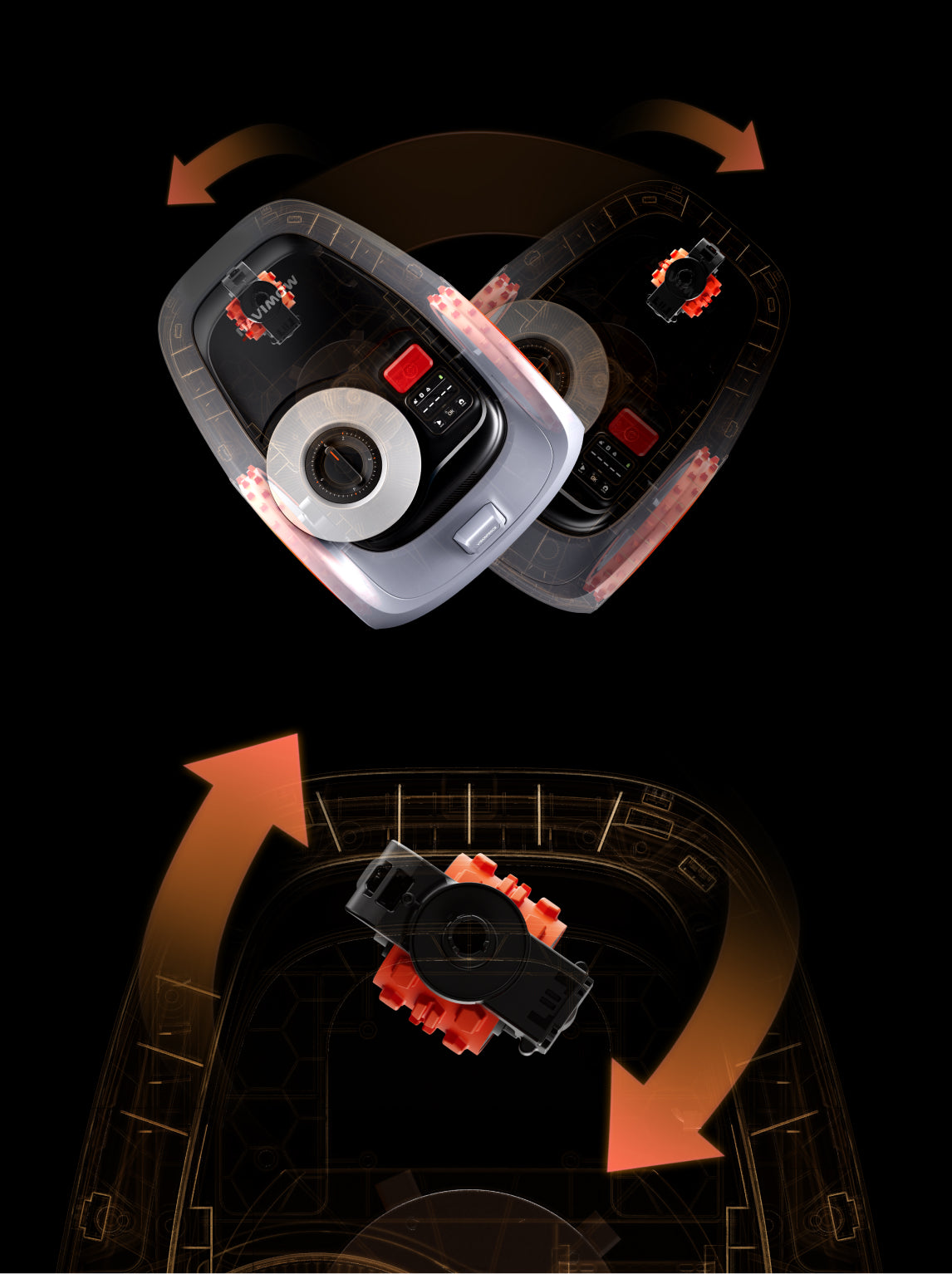
Other than navigation, the Navimow H2 is superior in precise cutting, slope handling, and obstacle detection. It’s equipped with a 100W motor and an advanced cutting module with 6 blades and an anti-clogging disc. It handles thick grass without any hassle.
With Terrain Adapt, it analyzes your lawn and divides it into optimized zones. It plans the ideal route, even on slopes. Because of Electronic Stability Control and off-road wheels, it handles slopes up to 45% (24°).

Lastly, the VisionFence™ detects 200+ obstacles. It offers 0.4-inch detection accuracy and senses lawn objects, everyday items, and suspended objects. It also identifies 20+ animal types and maintains a safe distance while mowing. Simply put, it’s an incredible robot lawn mower in every aspect.
Final Words
Modern wire-free robot lawn mowers can work under thick trees. The reason is that they use multiple navigation technologies. If there are no satellite signals, they can use vision or LiDAR technologies to navigate the lawn. The latest robot mowers have upgraded to Network RTK, which works through multiple providers. It does not fail under dense tree canopies.
If your lawn has lots of big trees and shady areas, you should avoid RTK-only mowers. They rely on satellite signals that are blocked by tree leaves and branches. Go with robot mowers that have multiple navigation technologies and can work in any situation.