Measuring the lawn area is a bit cumbersome, but lawn owners need to do it anyway. It's needed to select the right mower, order the total bags of seeds, calculate the fertilizer rate, etc. Without an accurate idea of the area, you will end up buying the wrong item.
Some lawn owners opt for professional services, but that's not required. Rather than paying someone to measure your lawn, you can buy fertilizers, seeds, or lawn equipment/gadgets. As a lawn owner, you can measure your lawn yourself. And we will tell you how to do it the right way.
Whether your lawn is small, medium, large, or extra-large, we will help you measure the area with perfection. We will introduce five methods to measure lawn area digitally and manually. You can decide the right one according to the feasibility and accuracy you need.
Let's measure the lawn area.
Digital Mapping Methods
For people who have the basic technical knowledge and can use online tools, digital mapping methods are the easiest and quickest. You can easily measure your whole lawn, no matter how large it is, within a minute.
But there are some limitations. These tools depend on satellite images, so if you have made recent changes in the lawn area, such as adding a swimming pool, garden, or flowerbed, it might not have those changes.
Secondly, they consider the whole area as plain land. If there are steep slopes at multiple places, the actual value will be a bit more than what's calculated.
1) Navimow’s Lawn Measuring Tool
You can measure your lawn area with Navimow’s lawn measuring tool in no time. It’s extremely simple, and anyone can use it without any hassle. All you need to do is select the space, and it instantly gives you the lawn area.
Step 1: Open the tool (Measure My Lawn) and enter the address in the search bar. If you have given location access to the browser, the tool will fetch your location automatically.
Step 2: Once you see your lawn on the map, click the Draw button.

Step 3: The cursor will change into “+”. Now, mark the points.

Step 4: Select the whole area by creating a closed loop. Once the area is selected, you will have the lawn area at the bottom left corner.

2) Google Earth
Google Earth is an excellent digital mapping method, and it's also free. Not only can you measure a rectangular lawn, but you can also measure complex shapes.
Step 1: Open your browser and go to Google Earth.
Step 2: On the left, click "+New" and then click "New map."

Step 3: You will see the globe on the screen. You can zoom in on it and try to find your lawn. But a better option is to enter the coordinates of your lawn. If you don't know the coordinates, you can use Google Maps to find them. Open Google Maps, and you will see your live location. Tap the location to note its coordinates.

Step 4: Enter the coordinates in the Google Earth search bar. It will show the lawn and the surrounding area.
Step 5: On the Google Earth toolbar, you will have a ruler icon. It's for measuring the distance and area. Click it.

Step 6: The cursor will change into "+." Now, you need to add points to cover the whole area. If it's rectangular, you need four points, but you can add as many as you can to cover complex areas.
Step 7: Once you make a closed shape, you will see the area on the right. You can also change the units of the area.

Manual Mapping Methods
Satellite imagery doesn't have the recent data, and it might not be able to distinguish between flowerbeds, pathways, and the actual lawn area. The digital tools can only give you an approximate value.
If you want to be more precise, you have to opt for a manual method. It gives you complete freedom, and you can choose the part of the lawn that's important and ignore islands and other areas.
It takes more time, but in the end, you have the accurate area of your lawn. It's worth the effort.
3) The Geometric Method
If you want to measure the area manually and with very high accuracy, you can consider the Geometric method. It's ideal for lawns that have straight corners and edges. As long as the lawn does not have too many curves or an absurd shape, you can go with this.
You have to divide the whole lawn into multiple simple geometric shapes. For instance, if the lawn is a large rectangle, you can divide it into multiple small rectangles to make it easier.
However, not all lawns are rectangles; you will also encounter some triangles and circles/semicircles after dividing the lawn. Thus, you need to consider other basic geometric shapes as well.
The benefit of this method is precision. You can cover every inch of the lawn. It's a time-consuming method, but you can calculate the area precisely.
Step 1: Divide the lawn into rectangles first. You can easily cover most of the area. Use wood sticks or pegs to mark the shapes.
Step 2: You will encounter triangles at the corners and sides. Mark them as triangles. If there are circles and semicircles, mark them accordingly.
Step 3: Once the whole lawn is divided into basic shapes, measure the sides of the rectangles. You can use a long measuring tape.
In the case of triangles, you need to measure the base and height. To make it simple, select one side as the base and measure it. Then, imagine a perpendicular line segment to the base that intersects with the opposite corner. This is the height of the rectangle; measure it.
Also, measure the radius of circles and semicircles.
Step 4: Calculate the area of each shape. You can use the following formulas.

Step 5: Finally, add all areas to get the total area of your lawn.
4) The Offset Method
The offset method is also a manual way to measure lawn area. It also has a high accuracy, but a bit lower compared to the Geometric method.
It's perfect for lawns with irregular shapes. No matter how curvy the lawn is, it works everywhere. You can use this method if the lawn is plain and there are fewer islands/items in between, such as a swimming pool or flower bed.
It requires less time and effort, and often, professionals use this method to calculate the lawn area.
Step 1: You need to find the longest straight line in the lawn. It's in the middle of your lawn and can be vertical or horizontal. Once you find the line, leave the measuring tape on the ground. It will help in determining the exact offsets.

Step 2: The baseline is set. Now, you have to mark the intervals. If the lawn is small, mark intervals every 5 ft. If it's medium, mark every 10 ft. In the case of large lawns, you can choose the intervals every 20 ft. But keep in mind, the shorter the interval, the more accurate it will be. In our example, we have marked intervals every 5 ft.
Step 3: At every interval, measure the width/height of the lawn. It's a line perpendicular to the baseline. You have to start from one edge and complete at the other. Write down the width/height at every interval.

Step 4: Once you have measured and noted everything, you only need to apply a simple formula.
Area = (Sum of all offset widths/heights) x Interval Distance
Suppose the sum of all heights at intervals, in our case, is 160 ft.
Area = 160 x 5
Area = 800 sq. ft.
If there is any island or obstacle, such as a swimming pool in the middle, measure the width/height at both sides and add both to get the width/height of the interval. It will automatically subtract the area of the pool.
The Grid Method
If your lawn has too many islands, such as flowerbeds, swimming pools, play areas, ponds, and trees, the Grid method is perfect.
It is excellent for extremely irregular and complex lawns, as it offers exceptional accuracy. All you need to do is divide your lawn into small squares or grids and then add the area.
Step 1: You need to mark grids across the lawn. For this, you can use stakes, string, or marking paint. If you have nothing like that, you can even use flour.
Step 2: In small lawns, you can make 5 ft x 5 ft grids. For large lawns, 10 ft x 10 ft is a better option. Mark parallel lines across the length of the lawn. Then, mark across the width of the lawn.

Step 3: By doing so, you will see small squares or grids in the lawn. Count all full squares and note the number. There will be some partial squares along the edges. You can count two half-squares as one for better accuracy.
Step 4: Once you have the number of squares in the lawn, you only need to apply a simple formula.
Area = Total number of grids x (Area of one square)
Suppose the total number of grids is 80, and the area of one square is 25 sq. ft. (5ft x 5ft).
Area = 80 x 25
Area = 2,000 sq. ft.
It's a very simple method because you only have to count the squares. If there are islands, you can skip their squares; there is no need for subtraction. Making grids requires a lot of effort, but it is worth it.
Choose the Right Robot Lawn Mower According to the Lawn Area
Up to 0.25 Acres
For small lawns up to 0.25 acres, the Navimow i2 AWD series is exceptional. There are currently two models available. The Navimow i206 AWD is for areas up to 0.15 acres, while the Navimow i210 AWD works for lawns up to 0.25 acres.
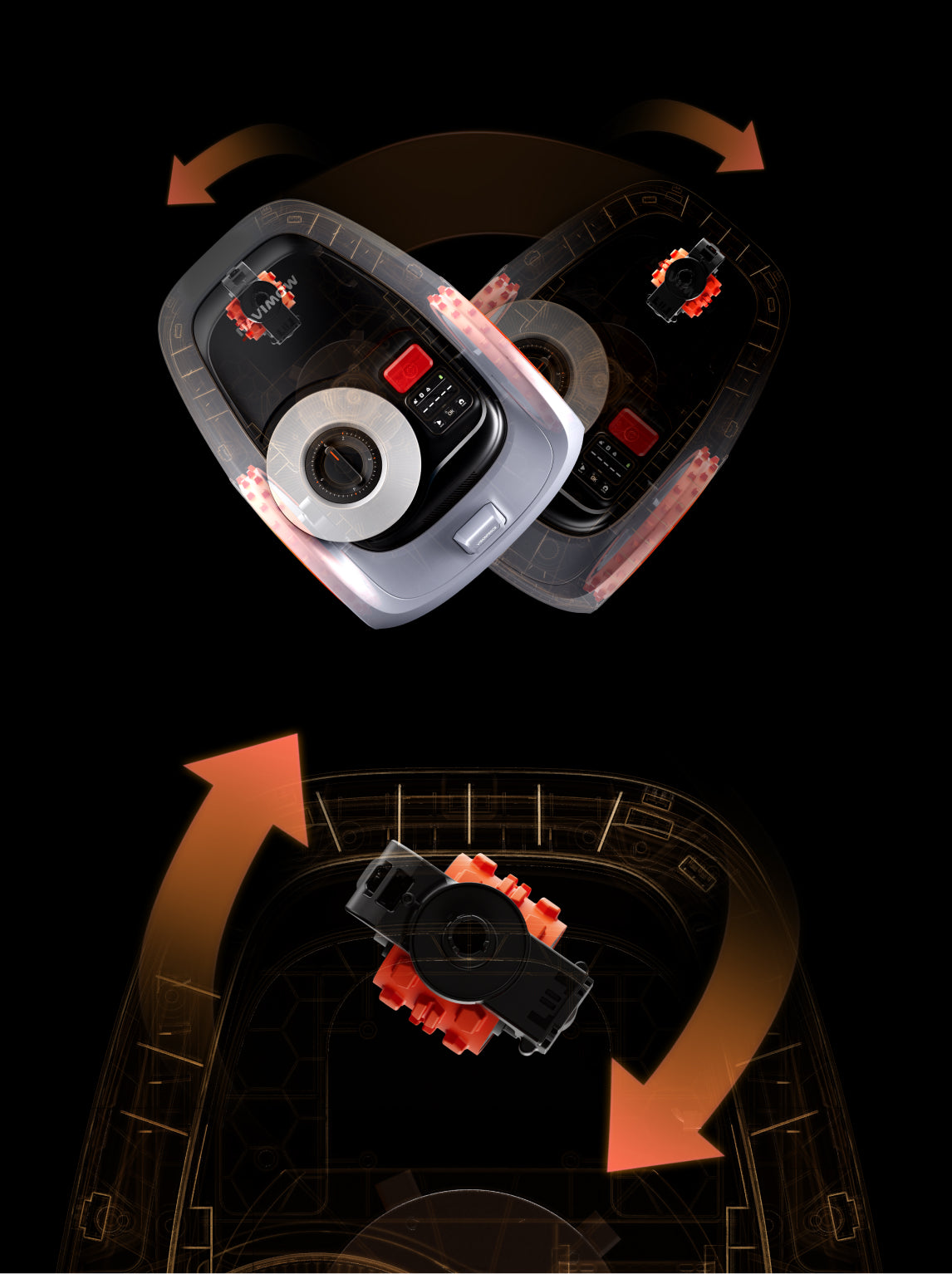
The mower is compact and affordable, but it is equipped with incredible features. With the All-Wheel Drive (AWD), it works on difficult terrain. It can handle slopes up to 45% (24⁰). It features Xero-Turn™ technology that allows it to make 180⁰ turns without damaging the lawn. That said, it can work in tight areas.
The mower navigates small-to-medium lawns precisely with the Network RTK. Its VisionFence™ detects 150+ obstacles and avoids them for safe mowing.

Up to 0.5 Acres
If you have a medium lawn up to 0.5 acres, you can go with the Navimow H2 series. It is an ideal mower for complex lawns with too many obstacles. It features an AI triple fusion system, which uses High-res solid-state LiDAR, Network RTK, and Vision technologies to offer optimal precision and reliability. Its intelligent 3D Terrain Adapt feature divides your lawn into optimized zones and plans the ideal route.
It creates a 3D map of your whole lawn and safely mows every area. It can detect 200+ obstacles in the lawn with 0.4-inch detection accuracy. It identifies 20+ animal types and automatically slows down from a distance of 3.3 ft.
There are two models available. The Navimow H210 is for lawns up to 0.25 acres, and the Navimow H220 mows lawns up to 0.5 acres.

Up to 1.5 Acres
For large lawns up to 1.5 acres, the Navimow X4 series is the best choice. The X430 covers lawns up to 1 acre, while the X450 is suitable for lawns up to 1.5 acres.
The mower is designed to conquer any terrain. With the All-Wheel Drive (AWD), dual suspensions, and patented Traction Control System (TCS), it can work on uneven surfaces, waterlogged lawns, and steep slopes up to 84% (40⁰). With the Xero-Turn™, it can make a quick 180⁰ turn like a zero-turn mower and mow narrow areas. It's the master of every scene.
It has two 180W motors and a dual-disc system to cut long, thick, and dense grass without any hassle. With its smart cutting technology, it automatically detects and lifts blades when handling challenging, tall, or tough grass. With EdgeSense™, it also takes care of the edges and mows within 2 inches of walls/fences and edge-to-edge along boundaries and transitions.
It navigates lawns with NRTK, 360° Vision, and VIO (Visual Inertial Odometry). It can precisely mow every corner of the lawn. Through VisionFence™, it senses 200+ obstacle types. It maintains a 3.3 ft distance and reroutes within 0.1 seconds.

Up to 6 Acres
The Navimow Terranox is the commercial solution. Users can automate lawn mowing for massive lawns with a fleet of hundreds of mowers. The CM120M1 covers an area up to 3 acres, and the CM240M1 mows up to 6 acres. They offer incredible efficiency and work at an exceptional speed. A single Terranox CM240M1 can mow an area equivalent to a standard football field in one day.
The mowers work on any type of grass, be it thick, long, or dense. They offer premium cut quality and maintain your lawn uniformly year-round.
They are equipped with AWD to mow any terrain and handle slopes up to 84% (40⁰).
Their intelligent object detection uses a 360° RGB Camera and ToF to detect obstacles and mow without any worries. They navigate lawns with NRTK, 360° Vision, and VIO (Visual Inertial Odometry), which is why they can mow massive areas with precision.

Final Words
Lawn owners would prefer to measure lawn area, but they have no clue how to do it. We have shared some digital and manual methods to measure the lawn area. Digital methods are excellent for quick results and having an approximate value.
But if you want to be more precise, you have to go with manual methods, and that's what professionals use. The Geometric method offers very high accuracy, and it's suitable for lawns with straight corners and edges. The Offset method is suitable for lawns with complex shapes and a few islands. The Grid method is for extremely complex lawns and irregular shapes. Even if there are dozens of islands, it can provide you with very high accuracy.
Now, you only need to choose the methods and follow the simple steps we have shared to measure the lawn area.