Not everyone is lucky enough to have a lawn without a steep hill. It makes mowing and lawn maintenance a bit more difficult.
You can't use every mower on a steep hill. Because there is a risk of slipping and sliding and ending up hurting yourself.
You have to be extra careful when mowing on a steep hill. You need to ensure your safety by taking a few measures and knowing how to do it the right way.
This comprehensive guide will tell you how to mow a steep hill safely. We will explain how you can use different mowers, the techniques you can use, and what to consider before mowing a steep hill.
What is a Steep Hill Exactly?
Before we dive into the details, it is better to understand what exactly a steep hill is. Lawns usually have terrains with slopes, but not every slope is steep.

If the lawn slope is about 10⁰, you don't have to worry about it. Almost all mowers work at this slope, even the heavy zero-turn mowers.
But when the slope increases from that level, it becomes a bit challenging. A 15⁰ slope is still manageable with most mowers, but you have to be extra careful.
After 15⁰, the mowers start to fail, and this is the starting point of a steep hill. You can't use a riding mower if the slope is more than 15⁰. However, push mowers and self-propelled mowers can still work until 20⁰.
The 20-25⁰ slope range is very steep. Normal mowers can't work on such a slope. And if the slope is more than that, such as 25-40⁰, it becomes a headache.
For a quick assessment, remember that a 1-foot rise over a 4-foot horizontal distance means a 14⁰ slope. It is called a 4 to 1 slope. If it is 1 foot over a 3-foot distance, it translates to an 18⁰ or 3 to 1 slope.
Why Mowing on a Steep Hill Is Challenging?
Weight Shift
On a plain surface, the weight of the mower remains balanced. That's because the mower's center of gravity is designed for that purpose.
When the mower climbs a hill, the weight of the mower starts to shift. It shifts towards the downhill wheels. So, if you are mowing upwards, the weight will be shifted to the rear wheels. And if you are mowing downward, the weight will be shifted to the front wheels.
Mostly, mowers can handle a slight shift in weight. For instance, you can mow up to a 10-15⁰ slope with almost any kind of mower. But after that, the mowers start struggling. If the mower's center of gravity moves outside the wheelbase, it will rollover instantly. Thus, you have to be careful while mowing on a steep hill.

Loss of Steering
Suppose you are mowing upwards on a hill with the help of a front-wheel drive (FWD) mower. While doing this, the weight will shift to the rear wheels.
If the slope is too steep, the front wheels will lift up, and the mower will lose steering. Then, the mower will not be able to mow on the slope.
Loss of Traction
While mowing on a steep slope, the wheels of the mower become unbalanced due to the weight shift. Thus, not all the wheels have enough traction on the ground. This increases the chances of slips and falls during mowing.
Especially if you have wet or succulent grass, the mower will struggle more. It will lose its grip.
Mechanical Issues
If you are using a gas mower on a slope, you should be aware of the mechanical challenges. The common issue is oil starvation.
On a slope, the oil collects at one side of the engine pan if the mower has a splash lubrication system. It does not reach the moving parts, which increases the friction. It will damage the engine in the long term and could lead to a halt.
Make sure the oil is at the optimal level before mowing a slope.

Physical Exhaustion
For lawn owners who have a push lawnmower, mowing on a hill becomes more difficult. It requires double the energy compared to mowing on a plain lawn. It leads to fatigue and accidents.
Safety Considerations for Mowing on a Steep Hill Safely
Before mowing on a steep hill, you need to check a few things to ensure safety.
Measure the Slope
You need to get an idea of the slope. Whether it is low, high, or extreme, you must know about it to select the right mower and technique.
The easiest way is to use your smartphone. Open the Level on your iPhone and place the device on the ground. It will give you an idea of the slope. For a better reading, use any straight object, such as a wooden plank, and then place the phone over it. You can also download a suitable app on your Android and do the same.
People also use the Rise Over Run method. For this, you need a 4-foot level. Hold the level perfectly horizontal. One end of the level will touch the uphill, while the other will be in the air. Now, measure the distance between the suspended end and the ground.
Then, use this formula:
Percentage Grade = (Rise/Run) x 100
Suppose the rise is 12 inches. We already know that the run is 4 feet (48 inches).
Percentage Grade = (12/48) x 100
Percentage Grade = 25%
According to the slope you have, you can opt for a suitable mower.

Moisture Check
The second thing is the moisture check. Never mow a wet lawn, even if it is a plain. And when it is a steep slope, things become extremely difficult.
Not only does the mower slip on a wet lawn, but it also compacts the soil. Later, you will have to do lawn aeration to revive the soil.
Make sure the grass is dry enough to cut. You can check the moisture level using a soil moisture meter.
If you don't have that, walk on the grass and notice your shoes and pants. If it is wet, you will see the grass clippings sticking to your clothes.
Even if you walk barefoot on the lawn, you will get the idea that the lawn is wet and not suitable for mowing.
People also do the snap test. Take a grass blade and bend it using your fingers. If it snaps, it means it is dry. But if it bends, it means the grass is wet.
Check out our detailed guide to know if the grass is dry enough to cut.

PPE
You need Personal Protective Equipment (PPE). Consider special footwear with high traction and steel toes. It provides enough traction, and if the mower tips over, it keeps your feet safe.
Wear long pants to protect yourself from rock and stick projectiles that are common while mowing. Use padded, vibration-dampening gloves to keep your hands stable while mowing on a slope. While mowing on a ride-on mower, don't forget to wear a helmet.
If the mower is too loud, you need hearing protection. Also, use eye protection to protect your eyes from high-velocity impact.
How to Use a Self-propelled/Push Mower on a Steep Slope?
Self-propelled and push mowers are designed for slopes up to 15-20⁰. They can work on these slopes, but you have to use the mower the right way.
Get Rid of the Debris
Before getting started, clear the lawn. Get rid of rocks, sticks, toys, and other objects on the slope. It must be clear and clean.
Small rocks and other items can be dangerous as they can cause injury at high velocity. So, make sure you clean everything.
Mow Across
Never mow up and down while using a self-propelled or push mower. Because it increases the chances of slipping and sliding. These mowers do not have large wheels or exceptional traction. So, you cannot risk using them up and down.
Suppose you are mowing up. If the mower slips, it will roll back over you. And if you are mowing down, you might end up hurting yourself with mower blades.
The best way is to mow across the slope. This way, the mower remains stable. It is slightly tilted, but it is not extremely heavy, so that's alright. You can mow across the slope without any worries.

Control the Speed
While mowing with a self-propelled mower, the most important thing is the speed. Keep the speed slow and steady. Go with the lowest propelled setting. It improves traction and allows you to keep the mower in control.
In the case of a push mower, you will have to exert more force. Just keep it steady and light. Take small steps.
Do Not Turn on the Slope
The golden rule is not to turn on the slope. If you want to turn, go to the flat part and then turn it. You can plan your route accordingly. Never turn in the middle, as you can easily lose the balance.
How to Use a Riding Mower on a Steep Slope?
While using a riding mower, you need to be extra careful. These mowers are extremely heavy, and you can seriously harm yourself. Keep in mind that the safe limit for most riding mowers is 10-15⁰. You can refer to the manufacturer's guidelines.
Seat Belt and ROPS
Some riding mowers, such as zero-turn mowers, have a Rollover Protective Structure (ROPS). It is a safety frame that keeps the rider safe during rollovers.
While mowing on a steep hill, you must engage the ROPS in the first place. Keep it upright and locked. Along with that, it is necessary to wear a seatbelt. Otherwise, you can get under the ROPS during rollovers.
If the mower does not have ROPS, you shouldn't wear a seatbelt. As soon as you feel the rollover, you must jump.

Mow Up and Down
Always mow up and down while using a ride-on mower. You cannot use them across the slope, as their weight can shift to one side, and the mower could roll over.
You can safely mow up and down. It keeps the center of gravity between the wheels. A better way is to mow only downwards on the slope. After coming down, move to a flatter area, turn the mower, and then come down again.
Keep in mind that while mowing up, there are chances of the front wheel lifting. The mower could lift if the slope is too steep.
Slow and Steady
Riding mowers are powerful and can go at high speeds. But on slopes, you have to keep it slow. Go with a steady pace and try to be as slow as possible.
The golden rule is to avoid sudden starts, stops, and variable speed on a steep slope. Moreover, you should keep the transmission engaged, no matter what. Even if you are going downhill, engaging the transmission is the key to having control.
Avoid Mowing Edges/End
Do not mow around edges with a riding mower. That's quite dangerous. The edges could have a steeper slope, and if you slip, you won't be able to control it and might bump into the fencing or the end of the lawn.
At the end of the lawn, you can use a string trimmer instead. Just mow the central area with a ride-on mower.

Empty the Bagger
If you are bagging the clippings, make sure to empty the bagger frequently. It is an added weight that can shift the center of gravity further. If the weight is too much, the front wheels might lose traction and cause the mower to flip backward.
Remember These Tips While Mowing on a Steep Hill
Raise the Deck
It's better to set the deck a bit higher than usual. If you keep it too low, it will put excessive strain on the mower engine, blades, etc. Thus, it is better to keep it high and let the mower exert more power for moving.
Secondly, it will also keep your turf safe. If the angle changes during mowing, the blade will not tear the turf.
Go Slow
Be patient while mowing on a slope. Go with the slowest speed. Often, people end up hurting themselves while mowing in a hurry.
Select the lowest speed and keep it steady. You should never change the speed on the slope. Otherwise, it will lose traction and balance.

Do Not Start/Stop
You need to keep the mower at a steady speed on a steep hill. Never start or stop on the slope. Start, stop, and turn on a flatter surface, and then mow the lawn without any worries.
Mark Dips
Before getting started, you should mark the dips and other uneven places on the slope. Avoid mowing these places with a ride-on mower. You can later use a string trimmer.
Often, people get their mower stuck in these places, and this is a common reason for rollovers.
The Best Way to Mow a Steep Hill—Get an AWD Robotic Mower
Mowing on a steep hill is difficult. And if it is too steep, you can't mow it using a normal mower. For most, we have already seen that the limit is 15-20⁰. Now, the question is, how do you mow if you have a steeper slope?
The simplest solution is getting an advanced robotic lawn mower. It will automatically cover every part of the lawn, including steep slopes. Usually, robotic lawn mowers can mow on slopes from 25⁰ to 40⁰, depending on the wheel drive, traction, and other features.
For steep slopes, the best option would be an All-Wheel Drive mower. It is extremely powerful and works on any kind of slope or terrain. It automatically mows the whole lawn, so you can save yourself a lot of time and also say goodbye to mower accidents.
The Navimow X4
If you have a large lawn up to 1.5 acres, you can go with the Navimow X4 series. The AWD mowers can work on slopes up to 84% (40⁰).

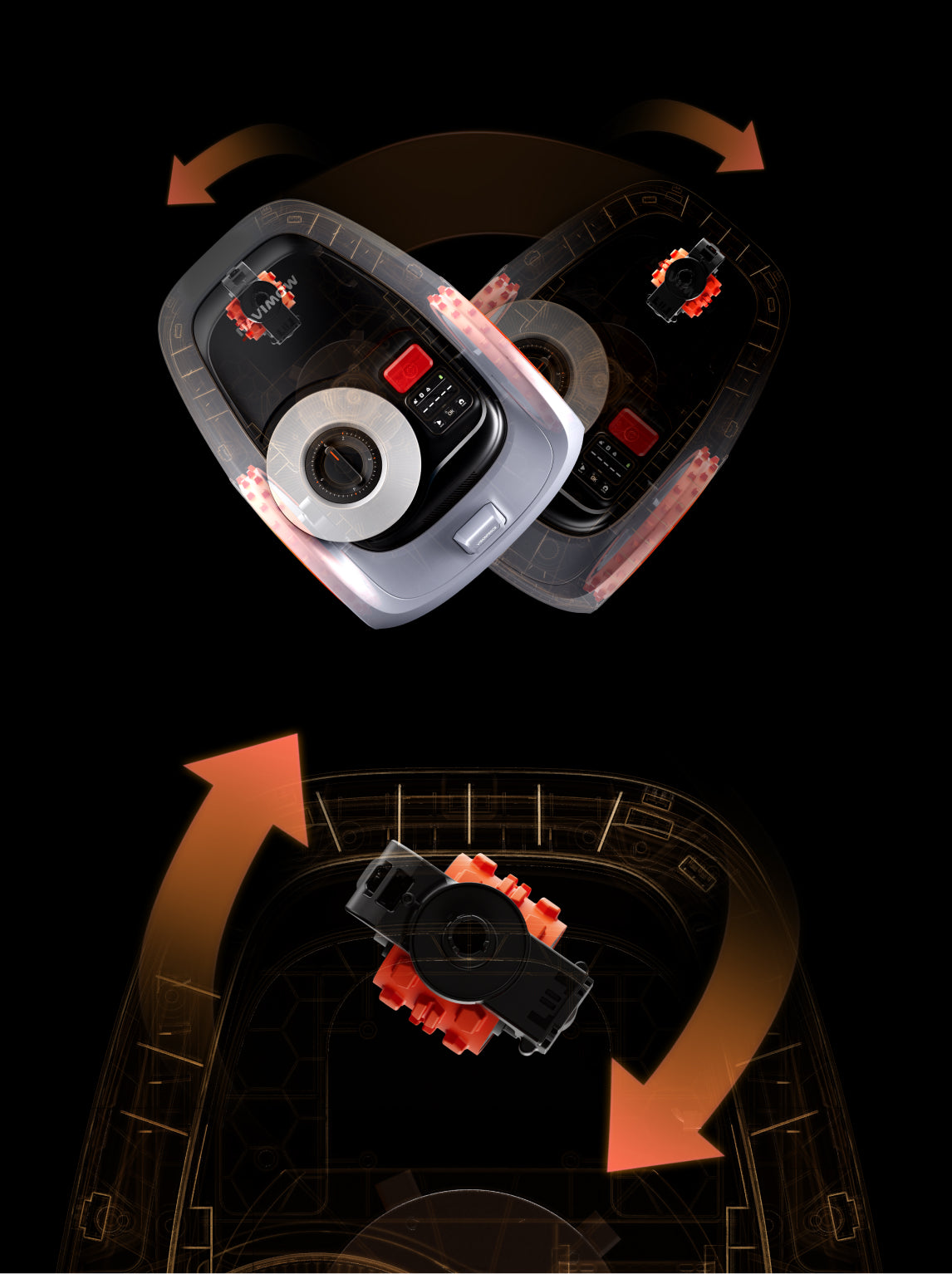
It has a 5:5 balance center-of-gravity distribution, a patented Traction Control System, and dual suspension to work on steep hills and any kind of terrain. It can work on stone slopes, pitted surfaces, border curbs, or any difficult surface where other mowers fail.
Another great thing about the X4 mowers is the Adaptive Blade System. The blade automatically floats over uneven ground, so you don't have to worry about scraping and damaging the lawn while mowing on a slope.

Not only that, but the mower has Xero-Turn™. It can take a 180⁰ turn without damaging your lawn. It can easily work in tight spaces.
The best part is that the mower is suitable for all kinds of grass types and conditions. It cuts long, thick, and dense grass. It even knows how to work in waterlogged lawns.

It uses EFLS™ NRTK, 360⁰ VSLAM, and Visual Inertial Odometry (VIO) to navigate in lawns. It precisely navigates with centimeter-level accuracy and detects 200+ obstacles. It understands your lawn and mows every slope, corner, and curb. It's an incredible mower with exceptional features and advanced technologies.
The Navimow i2 AWD
The Navimow i2 AWD series is for small lawns up to 0.25 acres. It is the only mower for mid-to-small lawns with All-Wheel Drive.
It can work on steep slopes up to 45% (24⁰). It can do lateral and diagonal moves on slopes. It can also go forward and reverse, and can even make 180⁰ turns with Xero-Turn™.

With the 9.8-inch off-road wheels and traction control system, it mows through difficult terrains. It works on root-covered terrains, uneven stone paths, vertical steps, etc. It mows every corner and tight space.
Despite being a compact and affordable mower, it uses ELFS™ NRTK and vision technology to navigate the lawn. It detects 150+ obstacles and offers incredible performance. It can even make patterns while mowing to help your lawn stand out.
FAQs
Can you mow a 30 degree slope?
You can mow a 30-degree slope with an advanced robot lawn mower like the Navimow X4. It has AWD, patented traction control, stable center of gravity, and various advanced features to mow slopes up to 84% (40 degrees). Keep in mind that you cannot mow a 30-degree slope with a normal mower like a push mower, zero-turn mower, or lawn tractor; it is too dangerous.
Is it better to mow uphill or downhill?
If you have a zero-turn or ride-on lawnmower, you should mow up and down. The best option is to go downhill only to keep the mower stable and have better control. You can turn the mower on a flatter surface to do downhill only. You can do it only for slopes up to 10-15⁰ as these mowers cannot work on steeper slopes.
Are zero turns ok on hills?
You can use a zero-turn mower on hills, but the limit is 10-15⁰. You can mow up and down at a slow and steady speed. If the lawn is steeper, you cannot use a zero-turn as it can roll over. For steep hills, the best option is a robot lawn mower.
Is a 3 to 1 slope mowable?
Yes, a 3 to 1 slope is mowable. It refers to a slope of 18⁰. You can use a self-propelled or robot lawn mower here. Never use a zero-turn or ride-on mower on it.