Robot lawn mowers are the preferred choice for lawn owners these days as they automate lawn mowing and make lawn maintenance hassle-free. They are the best to save time and have a perfectly cut lawn year-round.
But when the lawn has steep slopes, finding the right robot lawn mower becomes a real struggle. It’s not a problem with robot lawn mowers because even the powerful lawn mowers, like zero-turn mowers and self-propelled mowers, also fail. In fact, robot lawn mowers perform better than them.
Steep slopes are the biggest challenge for any kind of mower out there. But with the latest tech innovations in robotic lawn mowers, it has become easier to conquer even steep slopes. And that’s what we will discuss in this article. If your lawn has steep slopes, we have the perfect solution for you.
Why Do Some Robot Lawn Mowers Struggle on Slopes?
Loss of Traction
Normally, robotic lawn mowers can work on plain grounds without any hassle. Their tires, wheel drive system, and everything work well.
But when they are on slopes, the wheels can’t maintain enough traction. They start to slip and slide with the shift of weight. It usually happens when they try to go downhill.
Secondly, the wheel drive system is not strong enough to let the mower climb a steep hill. It often fails.
Thus, to conquer steep slopes, the mower needs to have good traction on the ground and a powerful wheel drive system to drive the mower.

High Center of Gravity
Robot lawn mowers are lightweight compared to engine-powered mowers. But they still carry batteries and motors.
Usually, robotic mowers are designed to work on slopes up to 20⁰. Their chassis can handle the weight shift during movement.
But when the mower tries to mow on a steep slope, the center of gravity shifts to a great extent, and the mower becomes unstable. It increases the chances of rollover or tip-over accidents.
To resolve this issue, the robotic lawn mower must be designed accordingly.
Damp Soil
When the soil is damp or muddy, it further reduces traction on slopes. Normal robotic lawn mowers cannot move on muddy soil, even on plain ground.
They need special tires with high traction as well as a traction control system to drive the mower on the slope.
However, mowing wet grass on muddy soil is not recommended. It will lead to soil compaction due to the weight of the mower. It will block the water, nutrients, and oxygen passage. Then, you will have to do lawn aeration.
Boundary Wires
If there are boundary or perimeter wires near the hill or slope, then mowing that area becomes more difficult.
Robotic lawn mowers cannot stop or turn because of momentum. When they are mowing downward, the friction and traction are low. They might cross the boundary wire. And when that happens, the mower loses its position and the lawn’s perimeter.
Too Much Steep Slope
Every mower has a slope limit. Usually, robotic lawn mowers can handle up to 20-25⁰ slope. If the slope is steeper than that, they might not be able to mow that area.
In such cases, normal robotic mowers fail. You need a powerful robotic mower with advanced traction and technology.
Why The Navimow X4 is the Best Robot Lawn Mower for Steep Slopes
Navimow has introduced the latest X4 series, which is capable of conquering any kind of terrain and mowing even steep slopes. Let’s see why it is an incredible option.
AWD and Xero-Turn™
The Navimow X4 series is equipped with All Wheel Drive (AWD), which makes it superior to normal robotic lawn mowers. It masters all kinds of terrains and works even on steep slopes.
All four wheels are powered to enhance traction on the ground and give the mower more control over the movement. Due to AWD, the mower can easily climb on steep slopes up to 84% (40⁰).

The benefit of AWD is that the mower can work even on uneven slopes. Normal robotic mowers will fail here. If one of their wheels is lifted, they lose their traction and control. However, X4 mowers are powered by all wheels. If one wheel is above the ground due to an uneven surface, the other wheels maintain the traction.
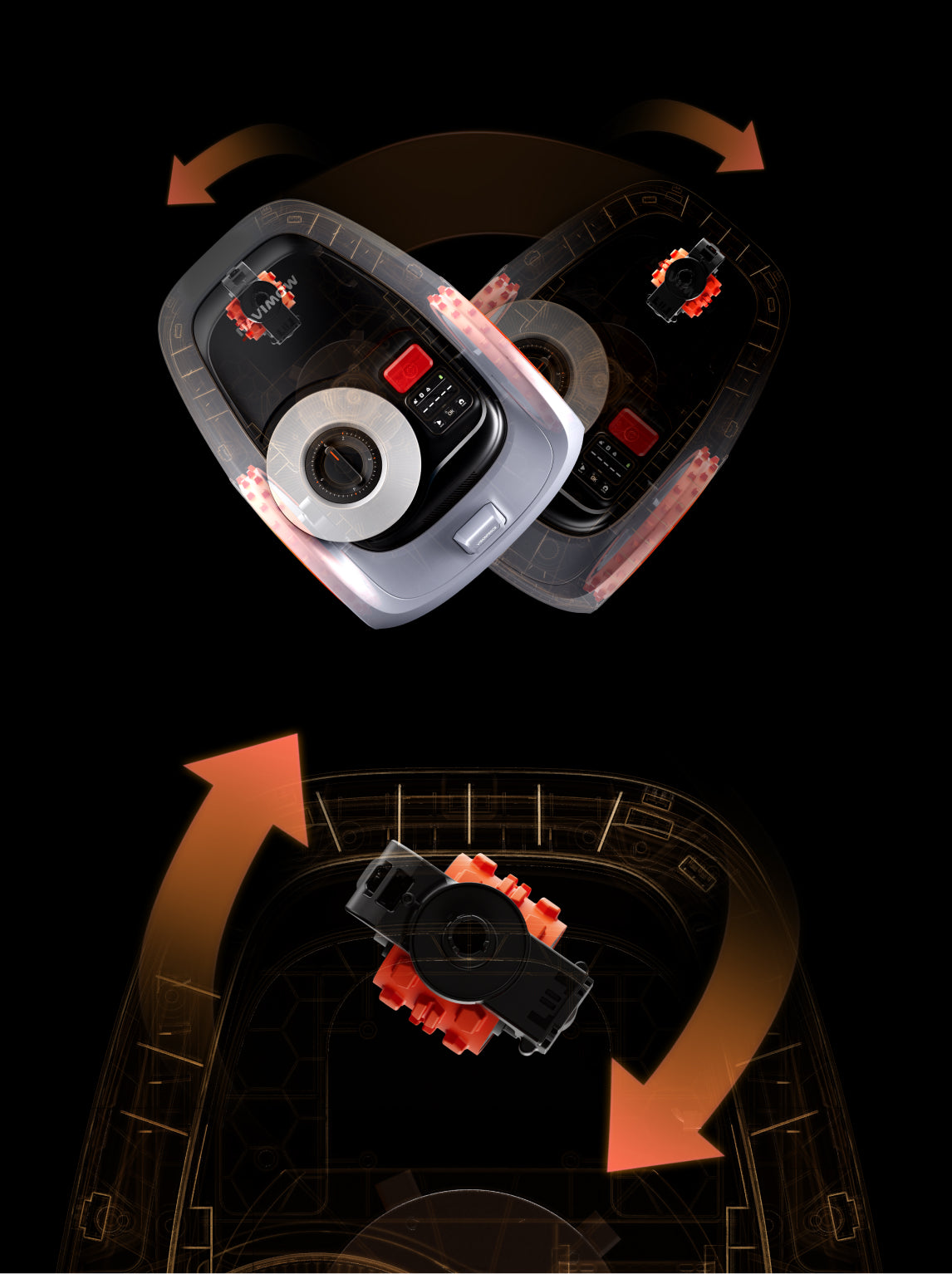
With the Xero-Turn™, the mower can take 180⁰ turns even on slopes. The front wheel steering system switches between zero-turn and automotive-grade Ackermann steering. Thus, even if you have fences and boundaries near a slope, the mower can mow there with perfection. Its front wheels take a 180⁰ without damaging your lawn by maintaining a good balance between traction and agile steering.

Dual Suspension
The X4 mowers have an innovative dual suspension system. It allows them to work on all terrains, even on slopes.
Whether it’s an uneven ground or a gravel surface with a slope, the mower can easily climb. The suspension helps in maintaining enough traction on the surface. Thus, they never lose control in complex terrains.
No matter if there are border curbs, potholes, or gravel paths, the mowers work in every situation.

5:5 Balanced Center of Gravity
We have already discussed that most robot lawn mowers fail due to a significant shift in the center of gravity on steep slopes. They cannot maintain their balance and may tip over.
The X4 mowers have a 5:5 balance center of gravity. Their chassis is designed to handle steep slopes up to 84% (40⁰). And the whole weight is distributed evenly to handle difficult slopes.
There are no chances of rollover or tipping over. They can easily climb and go downhill without losing their balance.

Patented TCS Technology
For optimal traction, the X4 mowers have the Traction Control System (TCS). It’s the patented technology that helps the mower conquer difficult terrains where other mowers fail.
The system automatically adjusts the wheel torque. Depending on the lawn surface, the torque is used to prevent slipping. Thus, even if there is a dip or muddy surface, the mower will easily go through it. It won’t stop or get stuck in the middle.

Adaptive Blade System
Lawn mowers usually have a fixed blade system. Which means the blade remains at the selected height during mowing.
It works well on a plain surface. But when there is an uneven surface or slope, it results in an uneven cut. You might even notice turf tearing if the blades touch the ground.
The Navimow X4 series has an adaptive blade system. With this, the blades automatically float over uneven ground. It minimizes scraping and damage to your lawn and ensures an even cut.

Wire-free Navigation & Momentum Control
The X4 series uses an advanced navigation system that does not need wires or antennas. Thus, if you have a steep slope or hills at the boundaries, you don’t have to worry about the mower going out of your lawn.
Common mowers fail while going downhill. They lose control and traction due to their momentum. But X4 is a bit advanced. Due to excellent traction, AWD, and a balanced center of gravity, it remains in control over the slope. It does not lose its balance and traction while going downhill. It can stop on a slope and make a turn whenever needed.
Secondly, it uses EFLS™ NRTK for positioning. It helps the mower know its exact position with centimeter-level accuracy. So, even if it is mowing on a downhill, it knows where to stop and where to mow.

With its cut-to-edge perfection, it mows within 2 inches of the walls or fences. Thus, it also takes care of edges on a slope.
Final Words
Mowing on a steep lawn is challenging, no matter what kind of mower you have. But with the latest Navimow X4 series, you can conquer difficult terrains and steep slopes. It’s a 4WD mower equipped with incredible technology and advanced features, including patented TCS, balanced weight, dual suspension, adaptive blade system, and advanced navigation technology. It works on any type of terrain and cuts grass with perfection. It truly automates lawn mowing.