Lawn owners plant new grass seeds to repair patches and make bare areas green again. But often, grass seeds fail to germinate because of incorrect planting, inconsistent moisture, wrong temperature, and various other issues.
As a lawn owner, you should master the art of planting grass seeds to keep your lawn lush, green year-round. All it requires is the right planting method and care to ensure incredible results.
We have made this comprehensive guide to teach lawn owners how to plant grass seeds the right way. We will share the step-by-step process that even beginners can easily follow. From soil testing to preparation and planting seed to special care, this guide covers every detail.
Step 1: Select the Right Time
Timing is extremely crucial. You have to plant grass seeds at the right time. Otherwise, it's putting money down the drain.
To choose the best time, you must consider the climate and the type of grass you have. In the US, the climate varies to a large extent between states, which makes it impossible to dedicate specific months to seeding.

If you live in the Northern region, you will have cool-season grasses like Kentucky Bluegrass, Fescue, and Perennial Ryegrass.
The perfect window for planting cool-season grass seeds is late summer to early fall (August to September). The primary reason is that cool-season grasses grow aggressively in the fall. The soil is warm enough for germination, while the air is cooler than in summer. Thus, there is no heat stress to prevent sprouting.
Another option for planting cool-season grass seeds is the early spring. As soon as the soil temperature stays 50-60⁰F consistently, you can start seeding.
Warm-season grasses, such as Zoysia, Centipede, and Bermuda, thrive in the Southern regions. You can plant them in late spring to early summer (May to June). It's the best period as warm-season grasses love high temperatures and grow aggressively in summer. Just make sure the soil temperature is above 65⁰F.

Soil temperature is the key to finding the right time to plant seeds. Use a digital temperature meter to measure the soil temperature. When it stays consistently in the recommended range, you can plant seeds without any worries.
For more details, check out the best time to plant grass seed. You can also visit our lawn care calendar to understand the growth cycle of cool and warm-season grasses.
Step 2: Pick Your Seed
There are plenty of options when it comes to selecting grass seeds. The first thing you need to decide is whether you want warm-season or cool-season grass. It depends on the region you live in. Understand the temperature and climate to pick the right option.
Cool-season grasses need temperatures between 60⁰F and 75⁰F to thrive. They cannot handle heat stress. They go dormant when the temperature goes above 89⁰F.
On the other hand, warm-season grasses require 80⁰F to 95⁰F. They prefer high heat and temperatures above 86⁰F to grow actively. They do not grow in cool areas, which is why they go dormant when the temperature falls below 55⁰F.

Whether you want warm-season or cool-season grass, you also need to consider the grass texture, growth habit, drought tolerance, maintenance level, wear tolerance, etc.
If you have a lawn with too much shade, you need shade-tolerant grass. To handle the wear & tear and high paw traffic, you can consider the best grass for dogs. All these factors matter a lot.
Check out Cool-season vs. Warm-season grass to select the best grass variety for your lawn.
Step 3: Calculate the Seed
Once you have decided on the variety, it's time to calculate the grass seeds you need. Firstly, measure the area you want to seed.
If there are multiple bare areas and patches, calculate the area of each and add them. If you want to seed the whole lawn, you can divide it into small rectangles and calculate the total area easily.
Once you have the total area, it's quite easy to calculate the amount of seed you need. The seeding rate is usually mentioned on the seed bag.
For instance, if the seeding rate is 4 lbs per 1,000 sq. ft. and you have an area of 5,000 sq. ft., you will need 20 lbs of seed.
You can use this simple formula to calculate.
Amount of Seed (lb) = (Area (sq ft) / 1000) x Seeding Rate (lb per 1,000 sq ft)

Step 4: Test the Soil
Before you overseed the lawn, it's better to test the soil. If there are any issues with the soil, you will get to know about it at the right time. Otherwise, your effort might go in vain.
You can check the pH levels and macronutrients in the lawn. For pH level, you can use a DIY test kit. A better option would be a digital pH meter probe.
The pH of the lawn should be between slightly acidic and neutral, which means 6.0 to 7.0. If the pH is too high or too low, it leads to nutrient lockout. The grass roots won't be able to absorb nutrients despite their availability. You must fix the pH levels before seeding.

For macronutrients (Nitrogen, Potassium, and Phosphorus), DIY kits are available, but a reliable option is lab testing. It takes some time, but it is worth it. It also tells you the measures you need to take if there is any issue. You can plan to test a few weeks before planting.
If your lawn has a shortage of any macronutrient, you can pick a suitable fertilizer for that. It will improve seed sprouting and support growth. For more details, here is our comprehensive lawn soil testing guide.
Step 5: Clean and Mow the Lawn
Clean the lawn before seeding. Get rid of the leaves, rocks, twigs, branches, toys, and other foreign objects in the lawn.
The lawn area must be clean and clear, ready to take action. If there are weeds in the lawn, you should remove them by hand. Take them out of the soil.
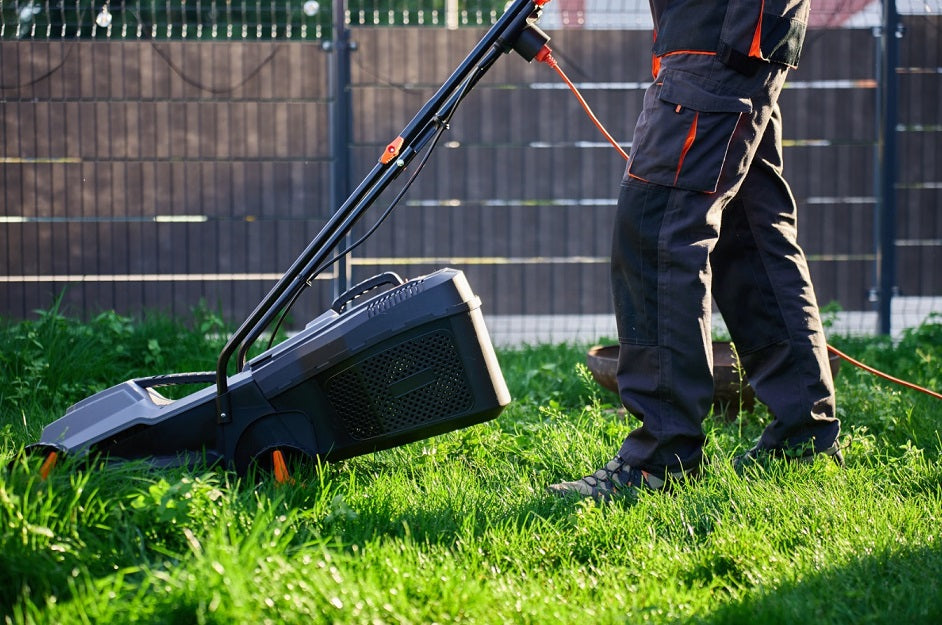
After cleaning, you need to mow the lawn. It's better to cut the grass a bit shorter than the best grass cutting height. It ensures enough sunlight reaches the new seeds.
You can use a Navimow robot lawn mower. Set the desired height and time to mow the lawn, and it will automatically mow everything for you. It will save you time so that you can focus on other steps and prepare for seeding. Secondly, it precisely cuts every area to ensure even germination results.

Step 6: Do Dethatching and Aeration (If Needed)
Thatch is the layer of dead organic matter over the soil. It accumulates over time, and when it goes more than half an inch, you should consider lawn dethatching.
If the thatch layer is thick and you don't do dethatching, the grass seeds will be caught in the thatch layer and won't reach the soil. Eventually, they will not germinate.
Even if the seeds reach the soil, the thatch layer will deprive them of water. It will soak up the water you provide to the lawn. Moreover, it will block oxygen and nutrient flow. The seeds won't be able to breathe and get the nutrients they need.
Therefore, it's better to remove the thatch layer first and then proceed to the next step.

Once the lawn has been dethatched, check for soil compaction. It's another problem that blocks the passage of air, water, and nutrients from reaching the seeds and the grass roots.
Compacted soil does not have any pores or air pockets. Its particles are tightly packed. That's why the seeds won't be able to germinate. Their delicate roots cannot grow in tight soil.
Lawn aeration is the technique used to reverse soil compaction. During this process, the plugs or cores are removed from the soil. Thus, a cavity is created, which loosens the soil and creates a passage for air, water, and nutrients.
The process is extremely beneficial for seeding. Firstly, when you seed after aeration, the seeds have better contact with the soil. The seeds go into the cavity/holes, which ensures higher germination rates. Secondly, the nutrients and water that you provide the lawn reach the seed. It also promotes the deep rooting of the grass.
To check if the soil is compact or not, use a screwdriver to push it into the soil. If it glides easily, it means the soil is fine. But if you need to exert your body weight or too much pressure to push 2 to 4 inches, the soil is compact.

Step 7: Add a Starter Fertilizer
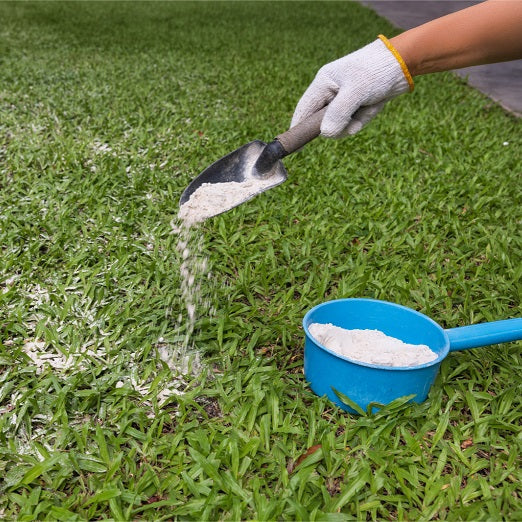
A starter fertilizer helps in the root development of new seeds. Unlike normal fertilizers, it's high in phosphorus. It releases nutrients slowly, which promotes the development of new seeds and does not harm them in any way.
But if your lawn is suffering from extreme nutrient deficiency, you should act accordingly. The lab test reports recommend how to solve the issue. You can go in that direction to improve the soil's nutritional content.
While choosing a starter fertilizer for your lawn, make sure to opt for a seeding-safe option. Often, fertilizers contain weed killers that can also kill your grass seeds.

Step 8: Spread the Seeds
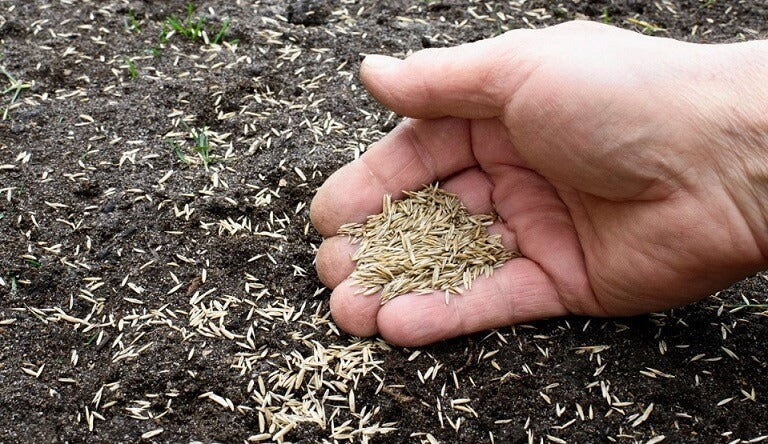
We have prepared the ground, and now, it's time for seeding. You are ready to plant new grass seeds in your lawn.
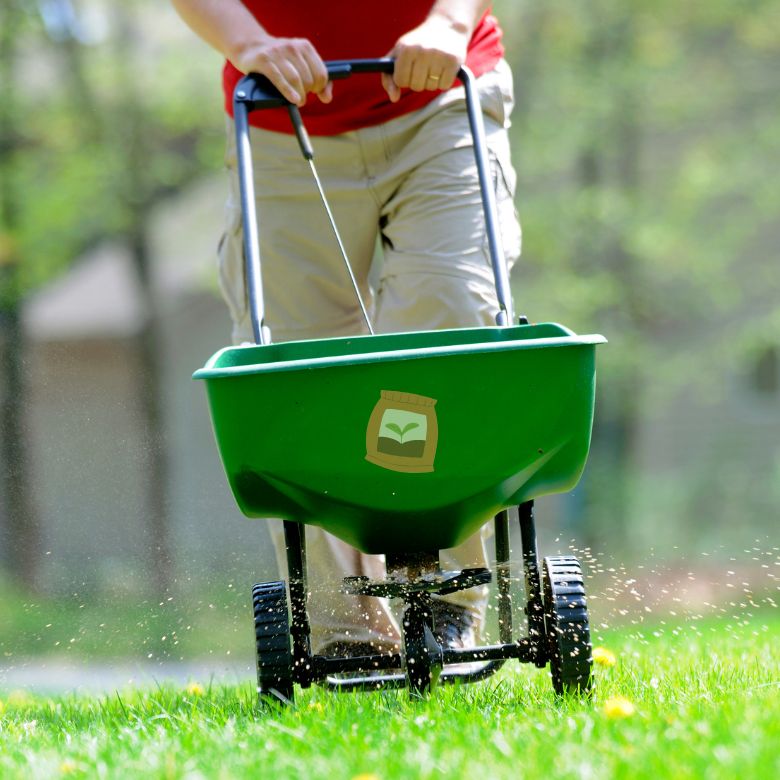
You can take a seed spreader and spread seeds in the lawn. It's important to adjust the dial appropriately. You can use the spreader on the sidewalk to get an idea.
The goal is to ensure even coverage on the lawn. It's better to seed the lawn twice. Firstly, use half of the seeds and go horizontally all over the lawn. Then, use the other half and cover the lawn vertically.

Step 9: Roll Over Seeds
Spreading seeds on the lawn doesn't mean you are done. You have to ensure optimal seed-to-soil contact. Otherwise, the seeds can change their position because of wind, and birds might eat them before germination.
The best way to improve seed-to-soil contact is to use a lawn roller. Use the roller over seeds, and its weight can push them into the soil. If you have a lawn roller, that's good. Otherwise, you can rent one.
How to Take Care of the Planted Seeds?
Grass seeds might fail if you don't take care of them. They are the baby seeds, so they need extra care and attention. Here's what you should do.
Water Properly
The most important thing is watering, and this is what many lawn owners do wrong. Grass seeds need to stay moist. You have to ensure the 1-inch top layer of the soil remains consistently moist.
If you fail to keep the soil moist, the seeds will die. Even one dry spell is enough to kill them, and there is no way to revive them. Thus, it is extremely crucial to keep the soil moist as it keeps seeds alive.

You may need to water 2-3 times a day. Water frequently but not deeply. Just a little spray will do the job. Do not overwater the area, as it does more harm than good.
You have to do frequent watering and keep the soil moist until the grass reaches 1 inch in height. After that, you can reduce the frequency and water deeply.
Here is our detailed guide on how long to water grass seed and how often to water grass seed.
Limit Activity
After planting new seeds, limit the activity in that area. Control kids and pets, as they can harm the delicate seeds and roots.
Do not walk in that area. Let the baby seeds grow properly before walking. Even if you want to water the lawn or do anything else, maintain distance.
The First Mow
Mowing is important for lawn care, but you have to be patient after planting new seeds. You should not mow until the grass is 3 to 3.5 inches tall. Mowing early can damage delicate sprouted seeds.
When it is time for the first mow, make sure the blades of the mower are sharp. Dull blades will tear the grass tips and increase the chances of diseases.
Secondly, follow the one-third rule for mowing. Do not mow more than one-third of the grass at once, as it puts the grass under stress. After the first mow, you can start mowing on a regular basis to maintain the recommended grass height.
The best way to mow the lawn regularly is "Automation." People often struggle to find time for lawn mowing, and this makes their lawn overgrown. At the same time, bad mowing habits deteriorate the lawn's health.

It's better to get a robot lawn mower. Schedule the mowing time and set the height, and the mower does everything on its own. It saves you from the hassle of pushing a mower. These mowers are extremely lightweight, so you don't have to worry about soil compaction. Secondly, they have sharp blades to offer clean cuts.
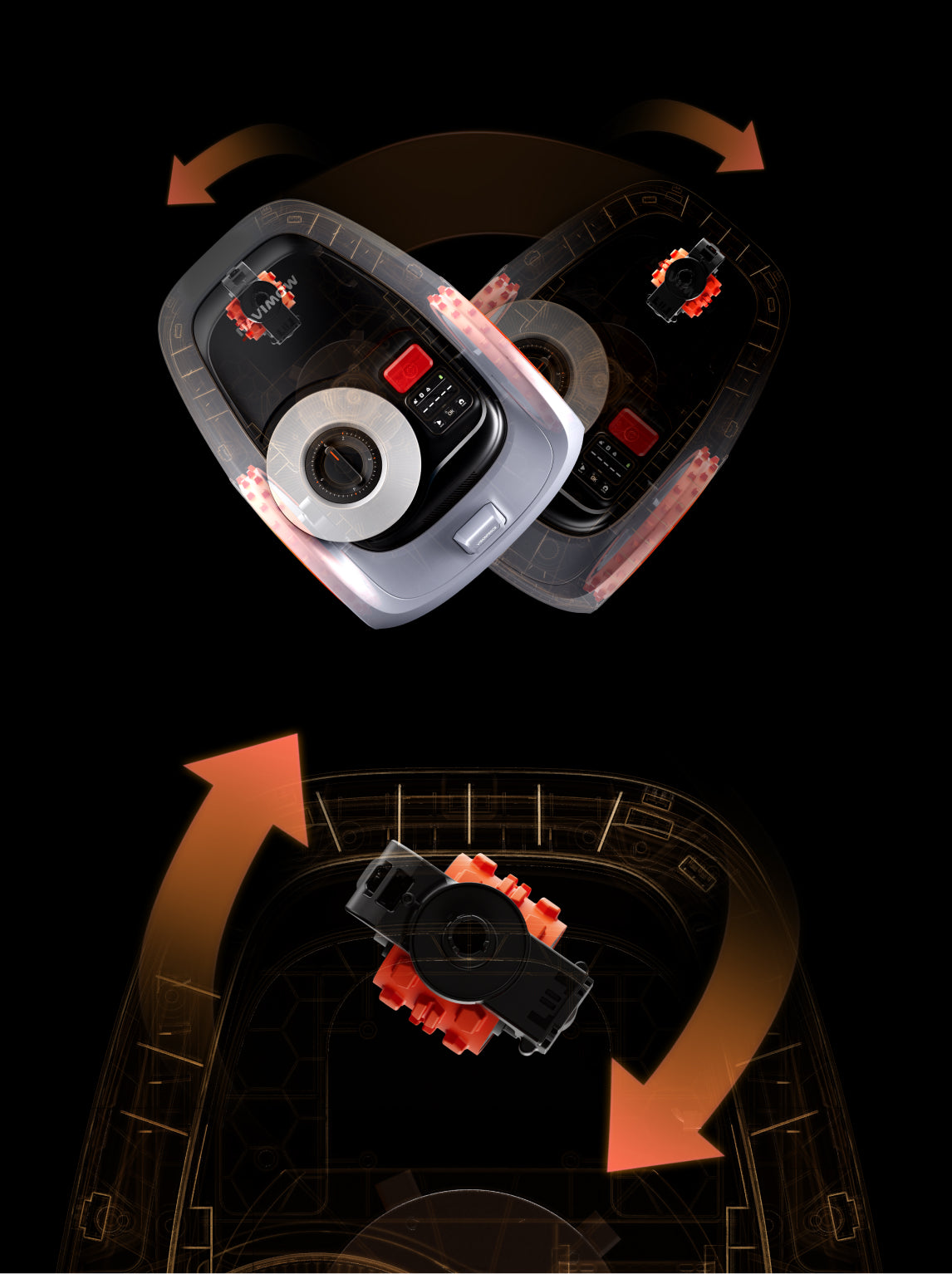
For a small lawn up to 0.25 acres, the Navimow i2 AWD is perfect. It's equipped with an advanced All-Wheel Drive (AWD) system that allows it to work on difficult terrains. Plus, it features Xero-Turn™, which allows the mower to take 180⁰ turns at its position. Other than that, the mower uses NRTK and vision technologies to navigate with accuracy. It can detect 150+ obstacles with VisionFence™ and ensure safe mowing.

If you have a large lawn up to 1.5 acres, the Navimow X4 series is phenomenal. Its Xero-Turn™ 4WD empowers it to dominate any kind of terrain, even slopes up to 84% (40⁰). It works in narrow and tight areas as it can take a 180⁰ turn without damaging the lawn.
It automatically maps your whole lawn and precisely mows every corner and edge. Its 180W motors cut any type of thick, long, and dense grass, while ensuring clean cuts. It precisely navigates large lawns with NRTK, 360° Vision, and VIO (Visual Inertial Odometry). With AI-Powered 360° VisionFence™ and Animal Protection, the mower detects 200+ obstacles with accuracy and performs even at night.

Final Words
Planting grass seeds is easy, and you can achieve excellent results. But you have to follow the right process. Beginners make various mistakes, such as planting at the wrong time, ignoring soil issues, and letting the soil dry out. That's why the seeds do not germinate. This comprehensive guide on how to plant grass seeds shares the step-by-step process you can follow to plant seeds in your lawn and make it green again. Once you have planted seeds, take care of watering, foot-traffic in the lawn, and mowing to enjoy healthy grass.