


Zero-turn mowers are the lawnmowing powerhouses. They are meant to mow large lawns in minimal time. They are much faster and powerful than other types of lawnmowers, which is why many lawn owners wish to have one.
But what many don’t know is that zero-turn mowers also damage your lawn in various ways. And that’s what we will be explaining in this guide.
We will go through the limitations of zero-turn mowers in detail and discuss how they damage your lawn in the long term. It’s better to be aware of these things before making a decision rather than regretting it after buying one.
We will also explain why Navimow X4 is a revolutionary zero-turn mower and how it addresses the issues of a traditional zero-turn mower. It offers lawn-friendly mowing with automation and advanced features.
Turf Tearing
The biggest issue with zero-turn lawnmowers is Turf Tearing, and it makes your lawn look horrible.
Zero-turn mowers are capable of making sharp turns. They can turn 360⁰ within their radius. Thus, you don’t have to move them back and forth to change their direction for mowing the next stripe. You can learn more about it by checking out What is a Zero-turn Mower?
Now, let’s understand how it tears the turf. A zero-turn mower has caster wheels at the front. These are free to move and go in the direction of the rear wheels. In short, they are not responsible for steering.
The rear wheels not only move the mower but also steer it. You can control each rear wheel separately and adjust its spinning direction and speed to maneuver.

For a sharp turn, you have to spin one wheel, while the other remains at its position. For instance, if you want to turn left, you need to spin the right wheel. The mower turns while the left wheel remains stationary and acts as the center. After turning, you’ll witness a divot under the left wheel. It damages the grass and its roots, and after some time, you see bare patches at these locations.
Similarly, when you take a zero-turn, you end up tearing more grass. For this, you have to spin both wheels at the same time but in opposite directions. The mower turns from its center without moving anywhere. The wheels tear grass while spinning for a zero-turn.
To avoid damaging the grass, you need to take slow turns and avoid sharp and zero turns. Secondly, many experts recommend doing a three-point turn. It can definitely save grass, but what’s the point of having a zero-turn mower if you can’t use its primary feature? You can mow lawns using other riding mowers.
Soil Compaction
Zero-turn lawnmowers are extremely heavy. The primary reason is their hefty 18HP+ engine, and then its bulky components like massive deck, large wheels, and transmission system contribute.
Lawn owners don’t need to worry about the weight of the lawnmower, as all they need to do is sit on it. There is no need to push or put any physical effort. However, this heavyweight is a burden on the lawn’s soil.
Usually, ZTR mowers weigh around 600 to 1,500 lbs. When you run it over the lawn regularly, it puts pressure on the soil and compacts it over time. After some time, the soil compaction will be severe, and it will prevent water, air, and nutrient exchange. Thus, the roots will not get what they need and will eventually die.

If you are using a ZTR mower, you need to take care of the lawn soil. Firstly, make sure the grass is dry enough to cut. Because wet soil compacts faster. It creates permanent ruts in the soft and saturated soil.
Secondly, you need to do lawn aeration to reverse soil compaction. It creates tiny holes by taking out plugs from the ground. Thus, the roots get access to water, nutrients, and air.
Grass Tearing
A ZTR mower cuts grass with excellent precision. But when the grass blade is dull, it damages your entire lawn.
It’s understood that the blade of a lawnmower should be sharp. But when it comes to a ZTR mower, you need to be extra careful. Its blades rotate at a much higher speed compared to normal lawnmowers, which is why it is more dangerous.

The dull blade at high speed rips and shreds grass tips. It does not cut it, so you witness uneven and frayed tips. It exposes grass to the airborne particles and the environment, and it becomes more susceptible to diseases.
You need to sharpen the lawnmower blade more frequently. And every time you think about mowing, you must ensure the blade is sharp enough. Because you can’t bear the damage it can do to your lawn.
Complex Controls
Zero-turn mowers are not everyone’s cup of tea. They have a steep learning curve, and it takes time to master the mowing skills.
For many beginners, it’s a bit difficult to control a ZTR mower. It only has two levers to control, and that seems easy. However, you have to use them precisely to control the speed and direction of the mower.

Often, people end up damaging their lawns using a zero-turn mower. After mowing, they witness divots and torn turf.
These mowers can run at a speed of 8-20 mph, and sometimes, this speed becomes overkill. It leads to poor cut quality and damage in different areas of the lawn.
Simply put, it’s difficult to use a ZTR mower, and users can make mistakes easily. The worst part is that you can’t undo those mistakes. If a divot is created in the lawn, you can’t get rid of it unless you treat that area.
Users need to learn how to operate a ZTR mower, and it takes time to become a pro. But still, there are chances of human error and mistakes that damage the lawn.
Unstable on Slopes
A zero-turn mower looks like a big, bulky mower that can work on any terrain. However, it struggles when you try to mow over a slope.
They can handle up to 10-15⁰, but anything higher, they become unstable. The primary reason is the uneven distribution of weight. The engine is at the rear side along with large tires, while the front area only has small casters.

When it climbs to a hill, the center of gravity shifts, and it starts to lose its balance. That’s the reason zero-turn mowers are not recommended for slopes.
They are quite unsafe, and anyone can lose control, no matter how expert and trained you are. You can’t control a 600-1,500 lbs lawnmower. You can end up damaging the lawn and hurting yourself.
Fails on Uneven Grounds
Another problem with zero-turn mowers is that they can’t mow precisely on uneven ground.
They have a very large deck, usually 36-72 inches. Thus, if there is an uneven surface under it, it will cut more or less in different spots.
For instance, if the wheel of the mower falls into a dip or goes over a bump, the deck will not remain straight. There will be a slight tilt, which will result in an uneven cut.
If it cuts more than the required amount, it will expose the soil to the sunlight. The roots heat up faster, and the water evaporates quickly. It can also cut the photosynthetic part or energy reserves and put the lawn area under stress. And if it cuts too high, the grass will be taller than its optimal cutting height.
The worst thing that can happen is lawn scalping. Due to an uneven surface, the large blade can tilt. It can hit the soil and gouge or shave the grass.
Thus, if the lawn is uneven, the result of a zero-turn mower will also be uneven.

Why Navimow X4 is Better than Traditional Zero-Turn Mowers?
ZTR mowers can severely damage your lawn, and we have seen how. They are not suitable for every lawn owner.
Instead of going with a zero-turn lawnmower, you can opt for a robotic lawnmower that has the same capabilities and does not damage your lawn. The Navimow X4 series is what you need. It is a robotic zero-turn mower that addresses the issues of a common zero-turn lawnmower and offers incredible performance in any type of lawn.
It has the latest Xero-Turn™ AWD technology. With the All-Wheel Drive (AWD), it can conquer any lawn. Be it an uneven lawn, steep slope, large curbs, gravel path, or huge dips and bumps, it never fails anywhere. It also helps dual suspension to work on any kind of terrain.

It has the revolutionary 5:5 balanced center-of-gravity distribution, which helps in maintaining traction on slopes. Secondly, it also has the patented Traction Control System (TCS), which prevents slipping. With all these extraordinary mechanisms, the X4 mowers can mow on steep slopes up to 84% (40⁰).
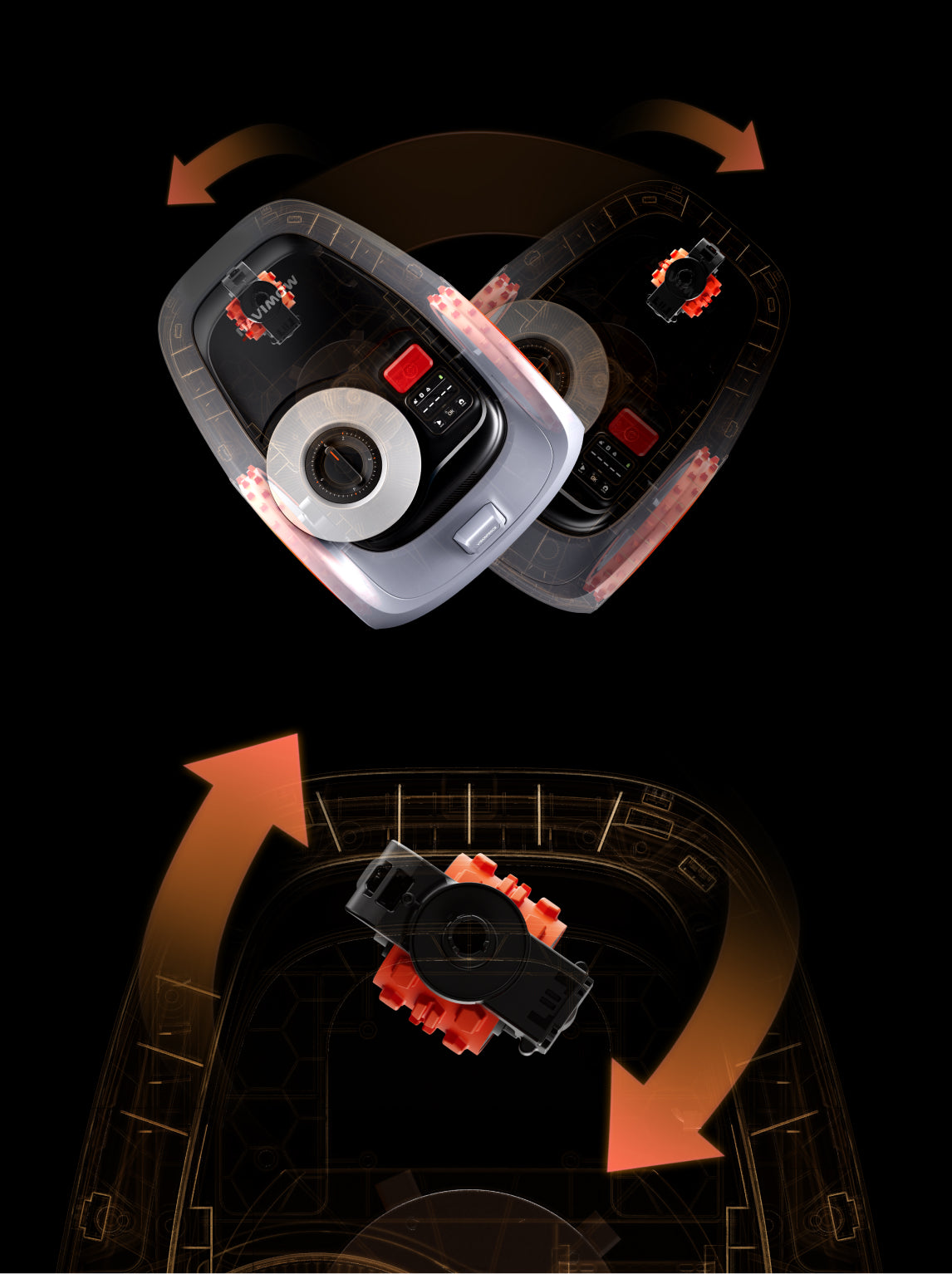
The Xero-Turn™ of the X4 series is extraordinary. The mowers can take a 180⁰ turn without harming the lawn. The reason is that it balances the traction and agility and keeps the steering under control. Thus, there is no turf tearing.

Instead of caster wheels as in zero-turn mowers, these robotic mowers have a revolutionary front-wheel steering system. It switches between zero-turn and automotive-grade Ackermann steering, which is why it masters both normal movement and zero-turn.

We know that heavy zero-turn mowers can cause soil compaction. However, the X4 robotic mowers are lightweight. They do not affect the soil in any way. Secondly, they are quiet, as the noise level is only 68 dB(A). Which is why they can operate without disturbing your family members and neighbors. On top of that, they are electric, so no harmful emissions.
The X4 robotic mowers can mow large lawns up to 1.5 acres. They have a large cutting deck of 17 inches and can mow at 2.6 ft/s. Moreover, they can cut thick, long, and dense grass as they have a dual-disc blade system, powerful 180W motors, and a smart cutting algorithm.

The most important thing about robotic lawn mowers is automation. You don’t have to waste your weekends and spend time learning how to mow. Just set the schedule and cutting height, and the mower will automatically do everything on its own. Even if you are away, it can keep your grass maintained at the optimal height.
Thus, it is better to switch to Navimow X4 and say goodbye to the common zero-turn mower that can damage your lawn.
FAQs
What are the disadvantages of a zero-turn lawn mower?
A zero-turn mower is expensive, loud, and difficult to use. Moreover, it leads to turf tearing and soil compaction. It can damage your lawn because of sharp turns and heavy weight. It does not work on slopes and uneven terrains.
Do zero turns tear up a lawn?
A zero mower can tear your lawn if you take a sharp turn or make a zero-turn. Its wheels can create a divot in the soil or tear grass while spinning at a high speed. You have to turn it slowly and carefully, and a three-point turn would be a better option to avoid tearing the turf.
Do zero-turn mowers flip easily?
Yes, when you use them on a steep hill, they can flip easily. The reason is their heavy weight concentrated at the rear end. At a steep slope, the front caster wheels lift up, leading to a backflip. It loses traction and control if the slope is over 10-15⁰. There is also a risk of side-overturn if you mow across a slope.


Share